Project Horae
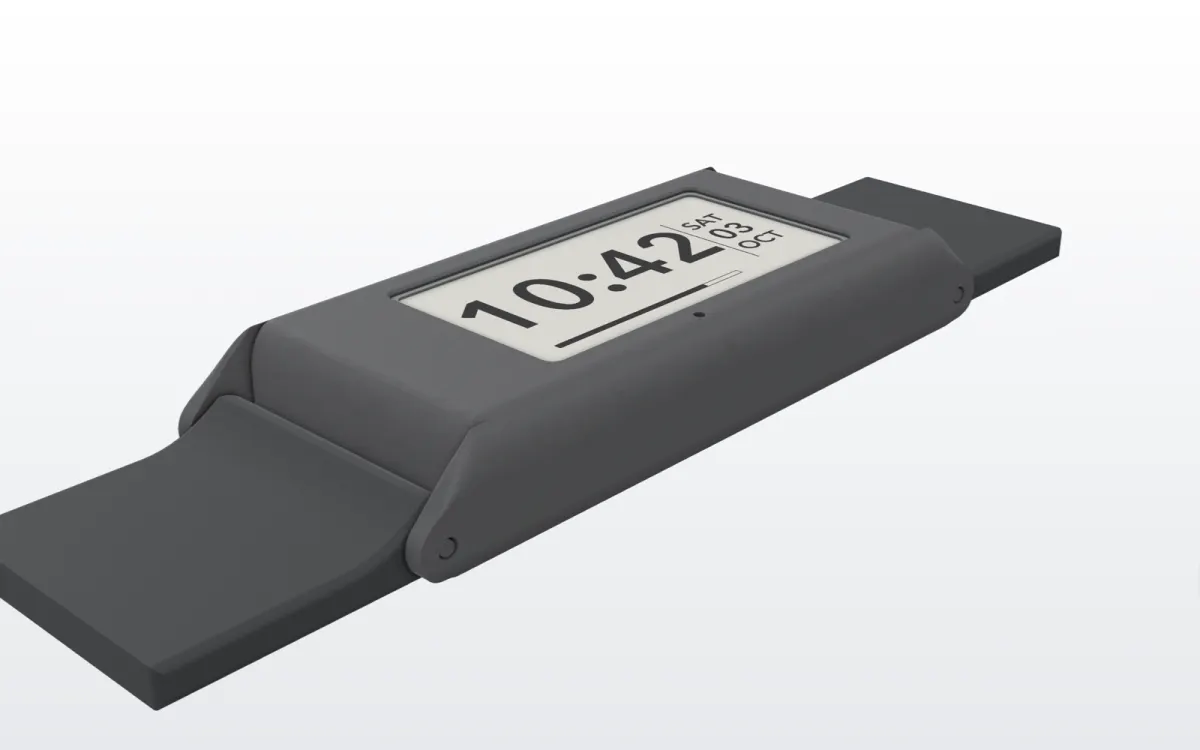
A miniaturized successor to Watchy: an open-source e-paper watch, rebuilt as thin as possible in a slim band form factor, like a Fitbit Charge instead of a square.
This page is the build log. It starts on day one and every milestone gets a photo or a screenshot.
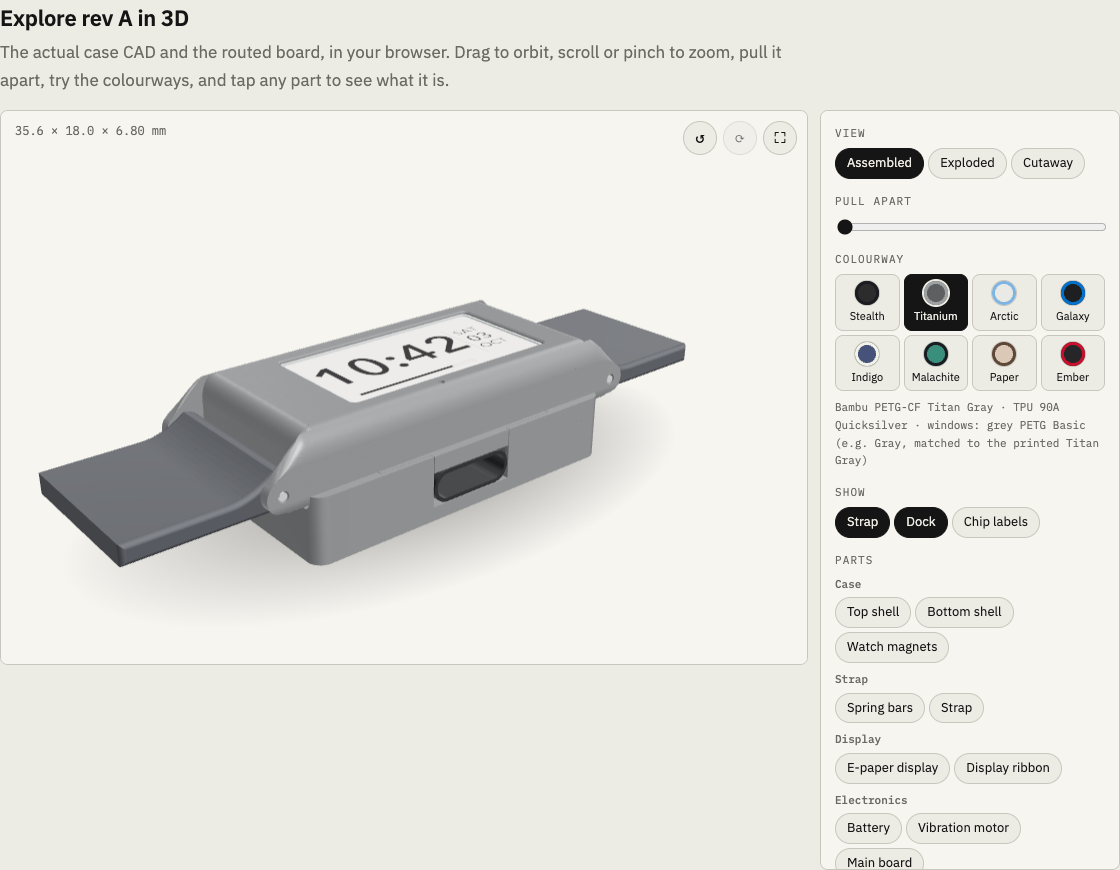
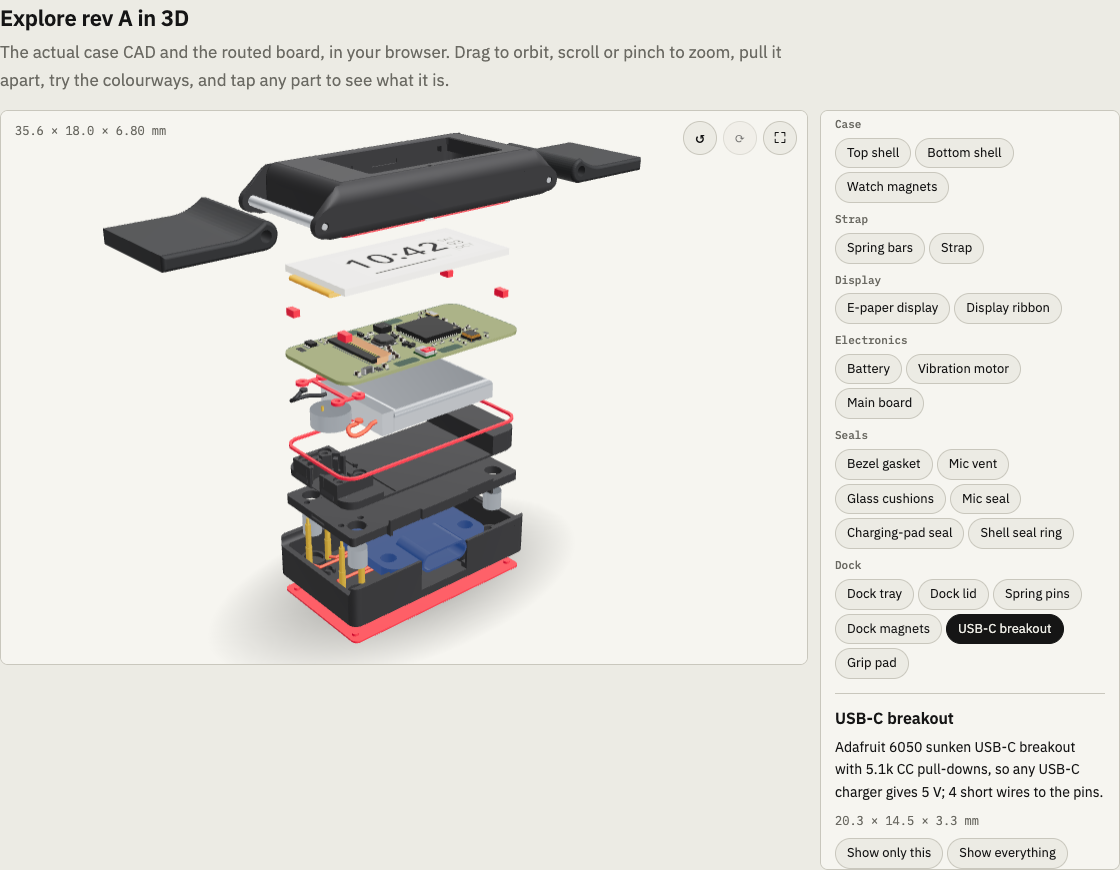
Explore rev A in 3D
The actual case CAD and the routed board, in your browser. Drag to orbit, scroll or pinch to zoom, pull it apart, try the colourways, and tap any part to see what it is.
Join the waitlist to get email when it's done and available to purchase
-
Pre-order review: 7 blockers found and fixed review
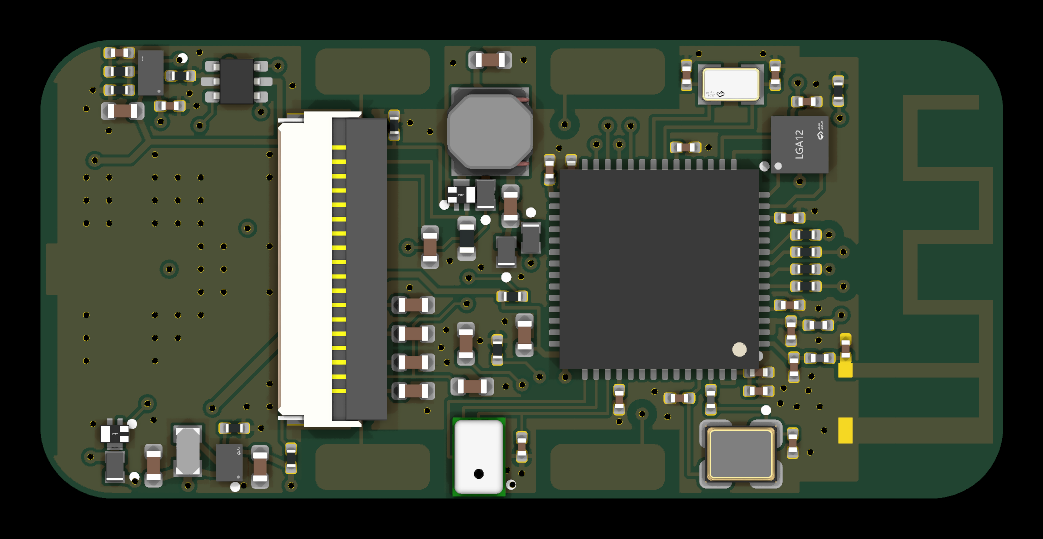
Before ordering anything, four reviews ran in parallel: the schematic and every part against its datasheet, the layout and fab files against JLC's limits, the size, and the shopping list. They found seven problems that would have sunk rev A, plus a long list of smaller ones. All are fixed, and the order and assembly guides are written.
- The display connector faced the wrong way. The FH34SRJ takes the ribbon on its fitting-nail side, so the display could never have been plugged in. J1 is turned around with its pins remapped. It also moved 1.7 mm, so the ribbon's U-bend keeps Good Display's 0.5 mm minimum radius.
- JLC would have built it wrong. These are all fixed: the board passes every design-rule check, and a probe of JLC's limits is clean.
- The placement file used the wrong coordinates, so every part would have landed about 141 mm off.
- The ESD chip needed a rotation fix.
- Both power chips' ball pads were below JLC's minimum.
- The RF match pads were close enough to merge.
- The ESP32's thermal vias sat open inside its solder paste.
- Traces ran under the touch electrodes.
- Better parts, same size:
- a buck inductor with 2.5× the current headroom;
- lower-leakage diodes;
- display rail caps that keep their value at 20 V;
- genuine ST ESD protection;
- the charger filter and caps TI asks for;
- series resistors on the touch pads;
- the mic moved off a pin the ESP32 drives during flashing.
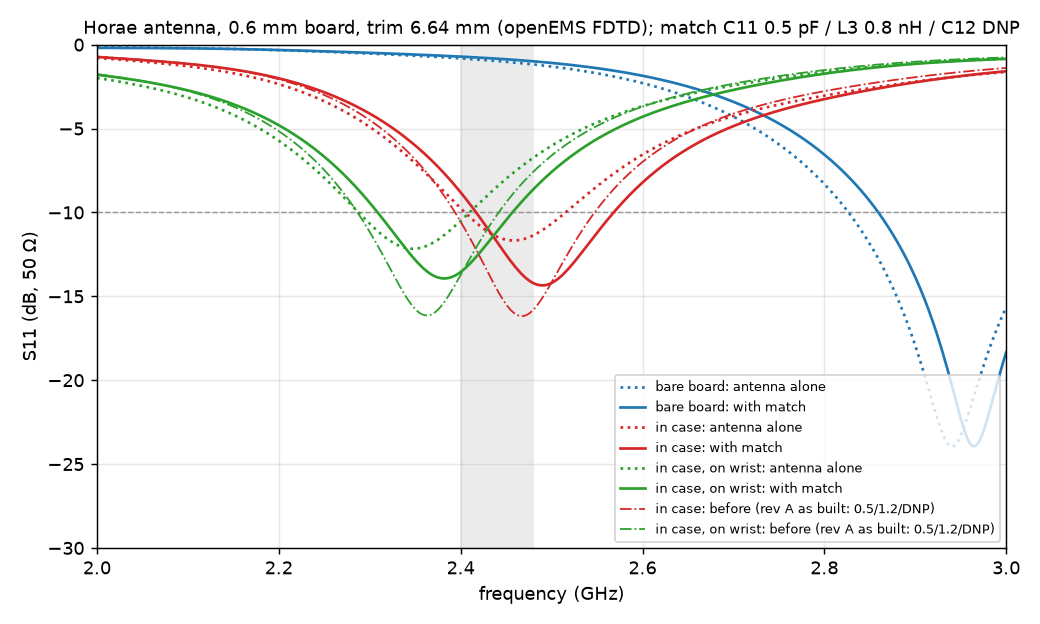
- Antenna re-simulated on the new layout: one part changes (L3 1.2 → 0.8 nH). The in-band loss is now at worst 0.78 dB, in the case and on the wrist.
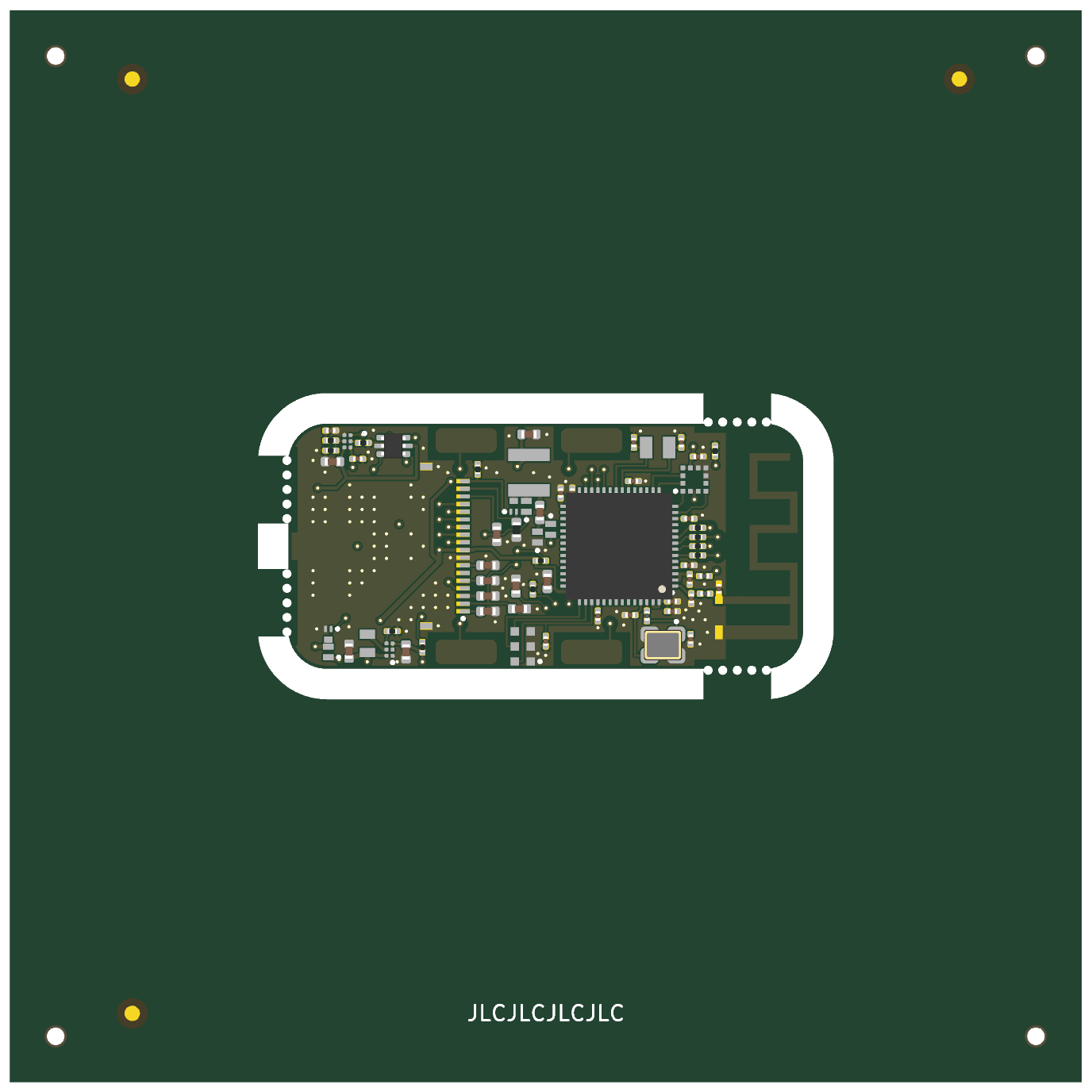
- Ordering: JLC only assembles boards in a frame of at least 70 × 70 mm, and its own panel would have meant paying for 16 boards. The board now ships in its own frame with snap-off tabs. Slightly wider vias and dropping a needless impedance test cut the bare boards from about US$96 to US$46.
- Thinner? Not without a trade-off:
- the tallest parts (the display connector, the booster inductor and the mic) have no lower equivalents;
- JLC won't assemble a 4-layer board under 0.6 mm;
- no thinner display exists.
- Case:
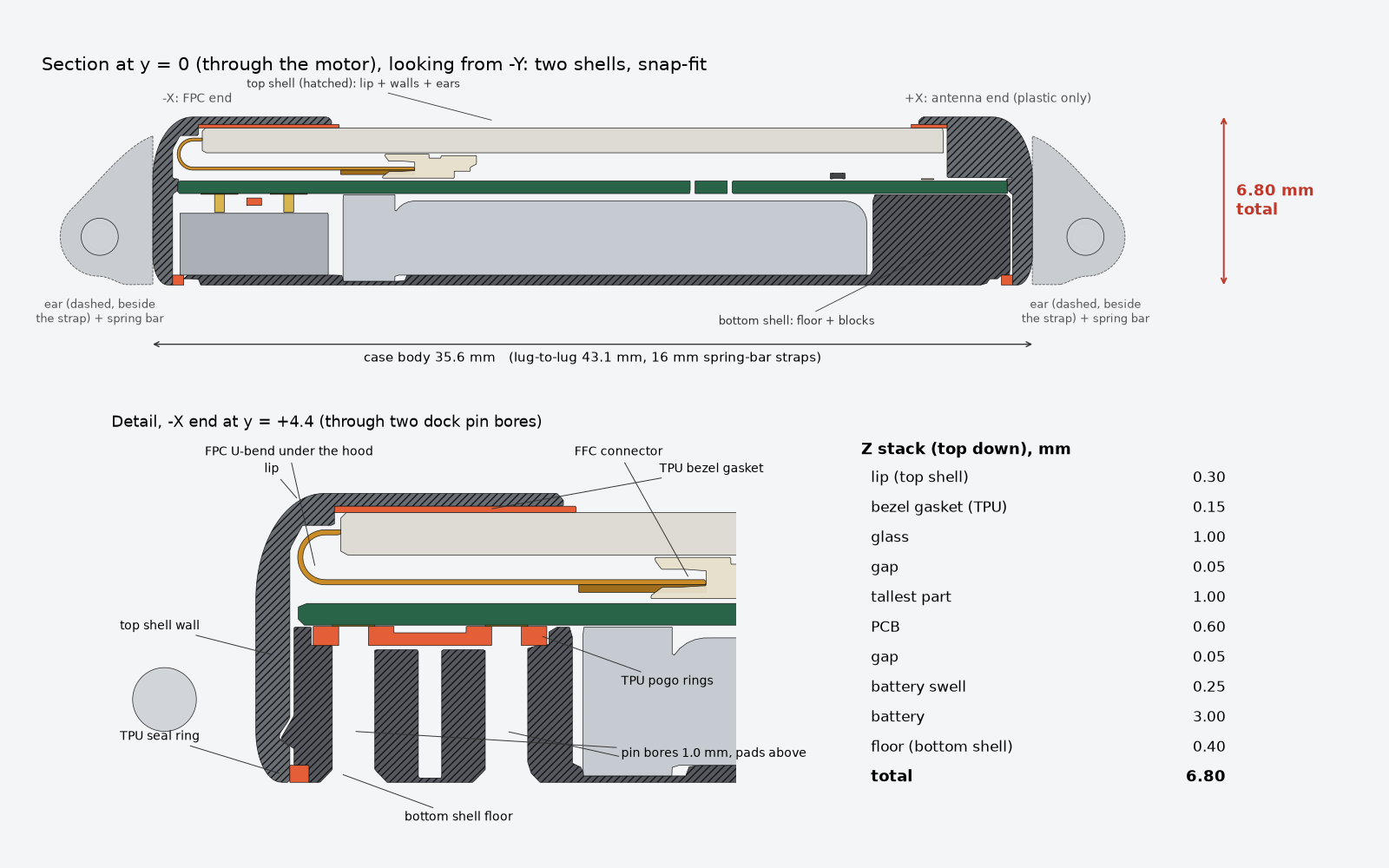
- the board now sits 0.2 mm off the walls (JLC cuts outlines to ±0.2 mm), and six crush ribs centre it;
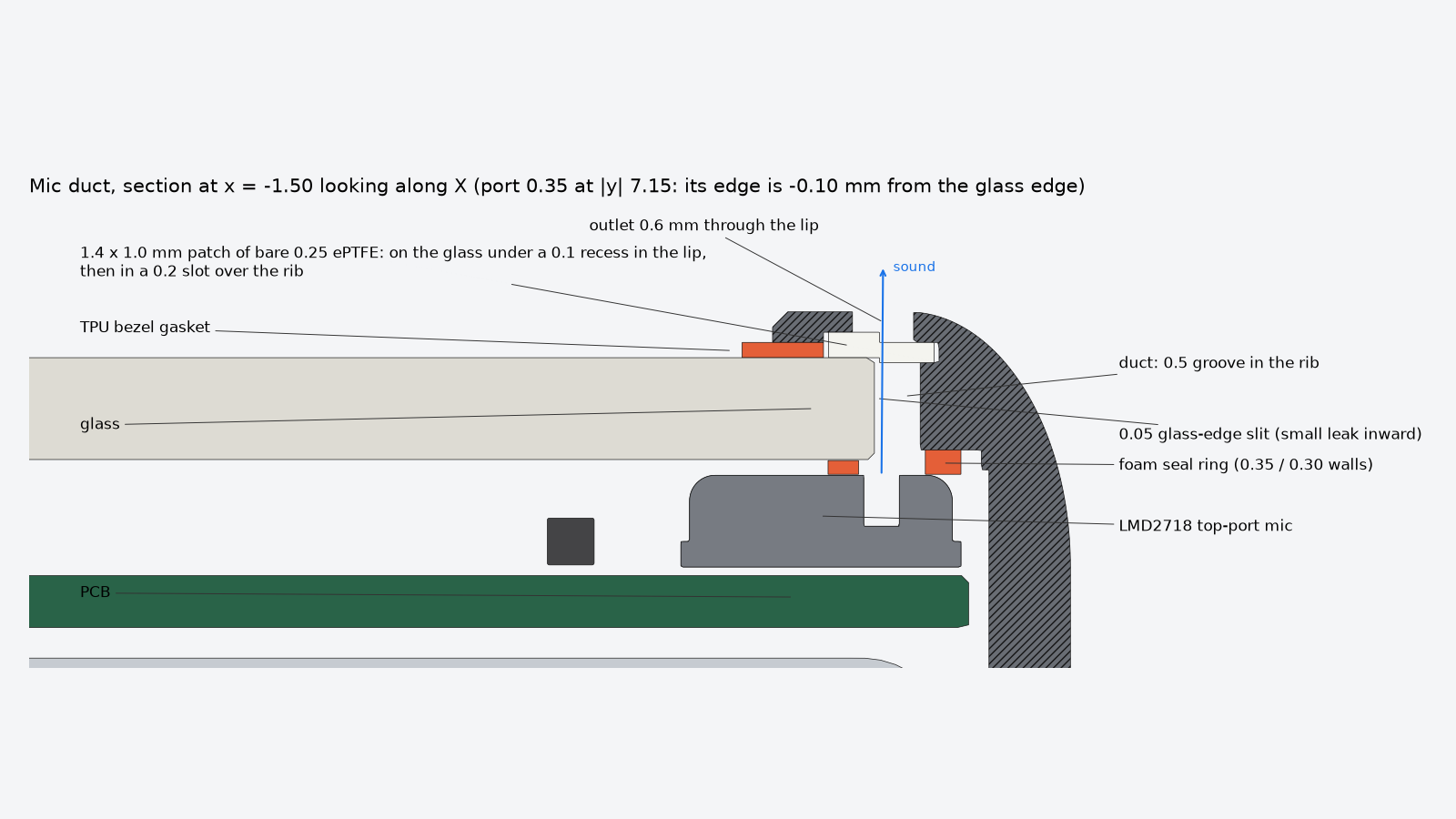
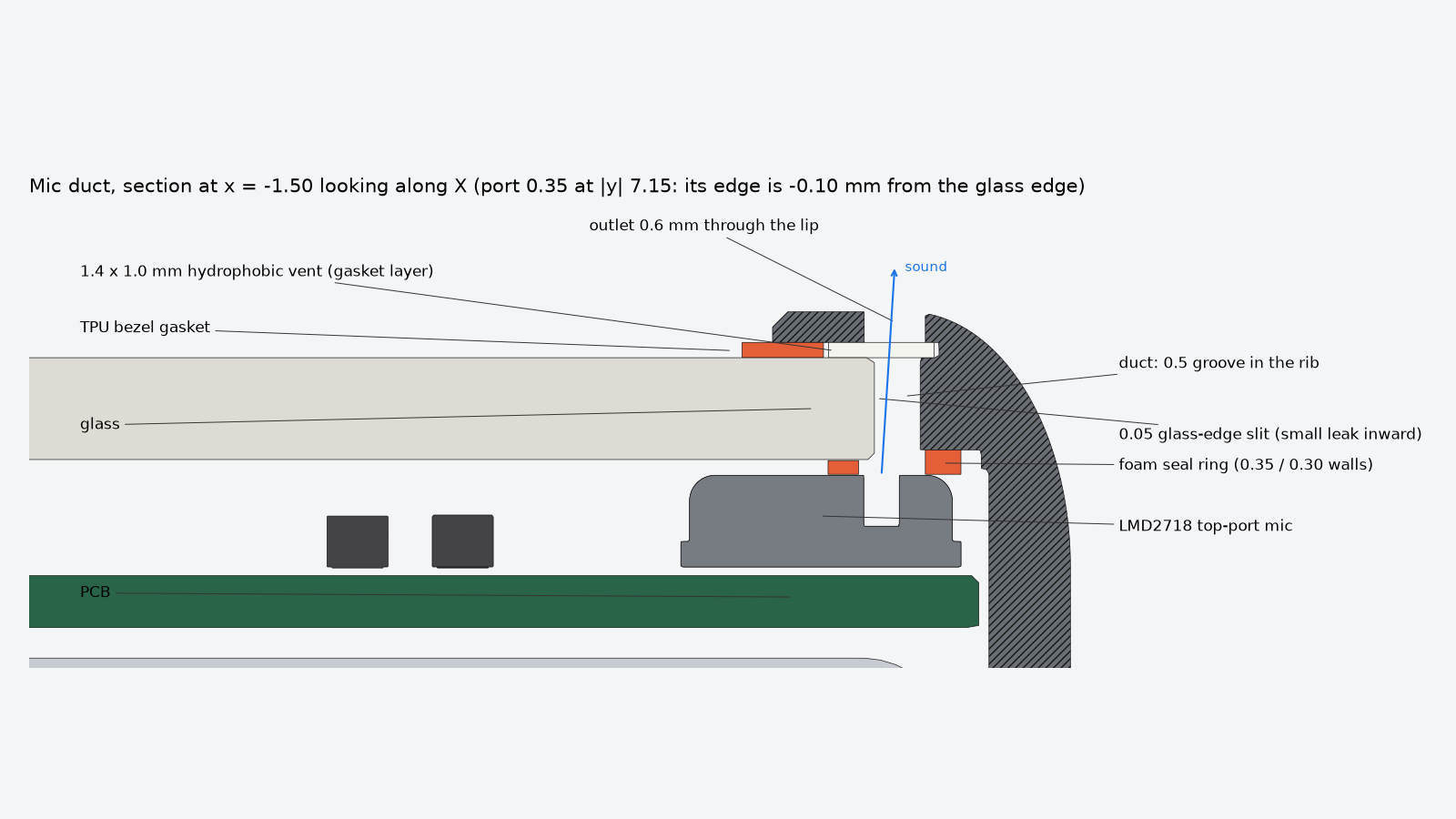
- the mic vent takes ePTFE film you can buy;
- every TPU part is now 90A;
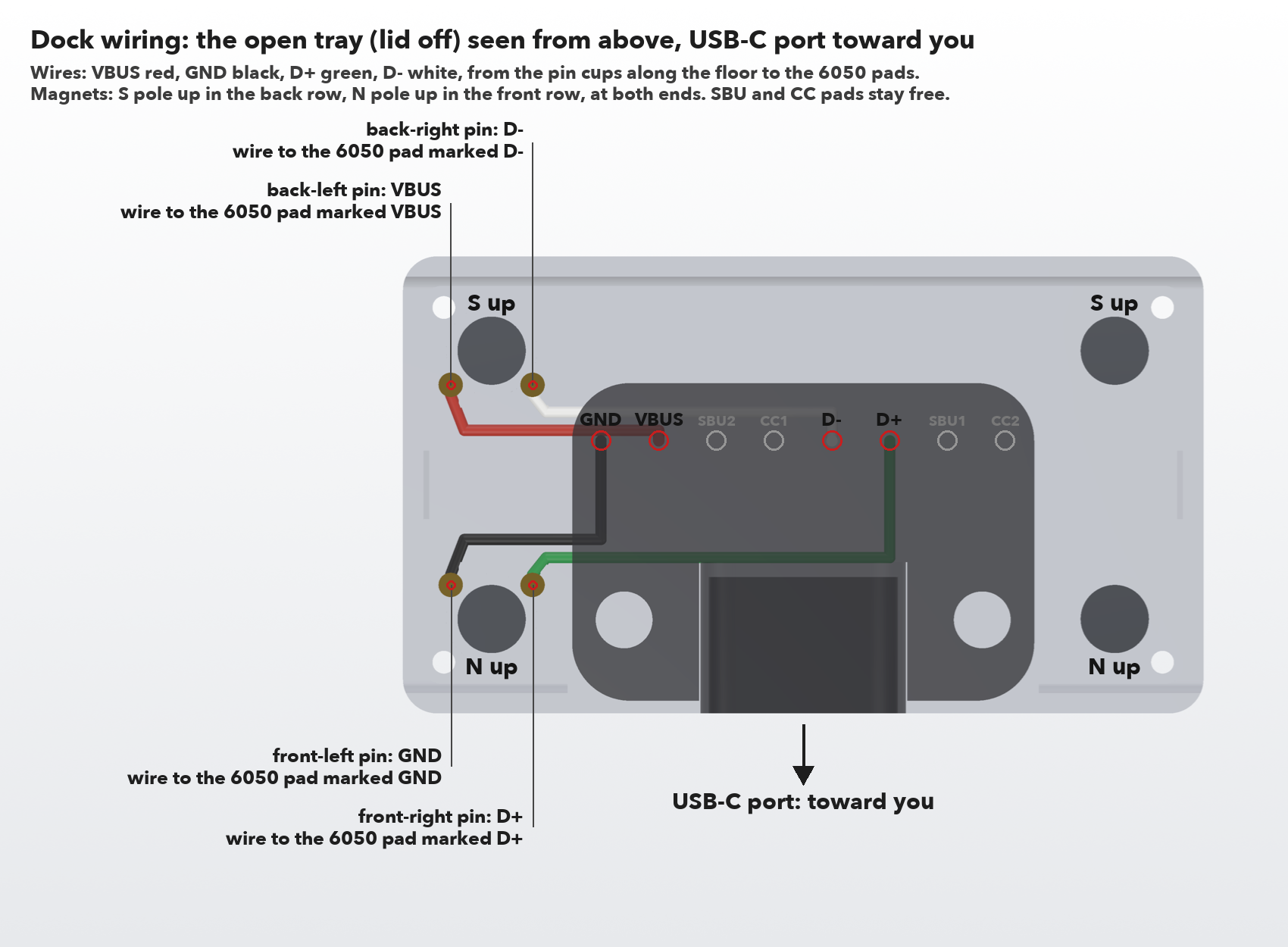
- the dock has a wiring diagram.
- Ready to order: ORDER.md has every JLC setting and a shopping list with Canadian sources: about C$640 to C$780 for 2 watches and a dock. ASSEMBLY.md covers the test print, bench bring-up and assembly.
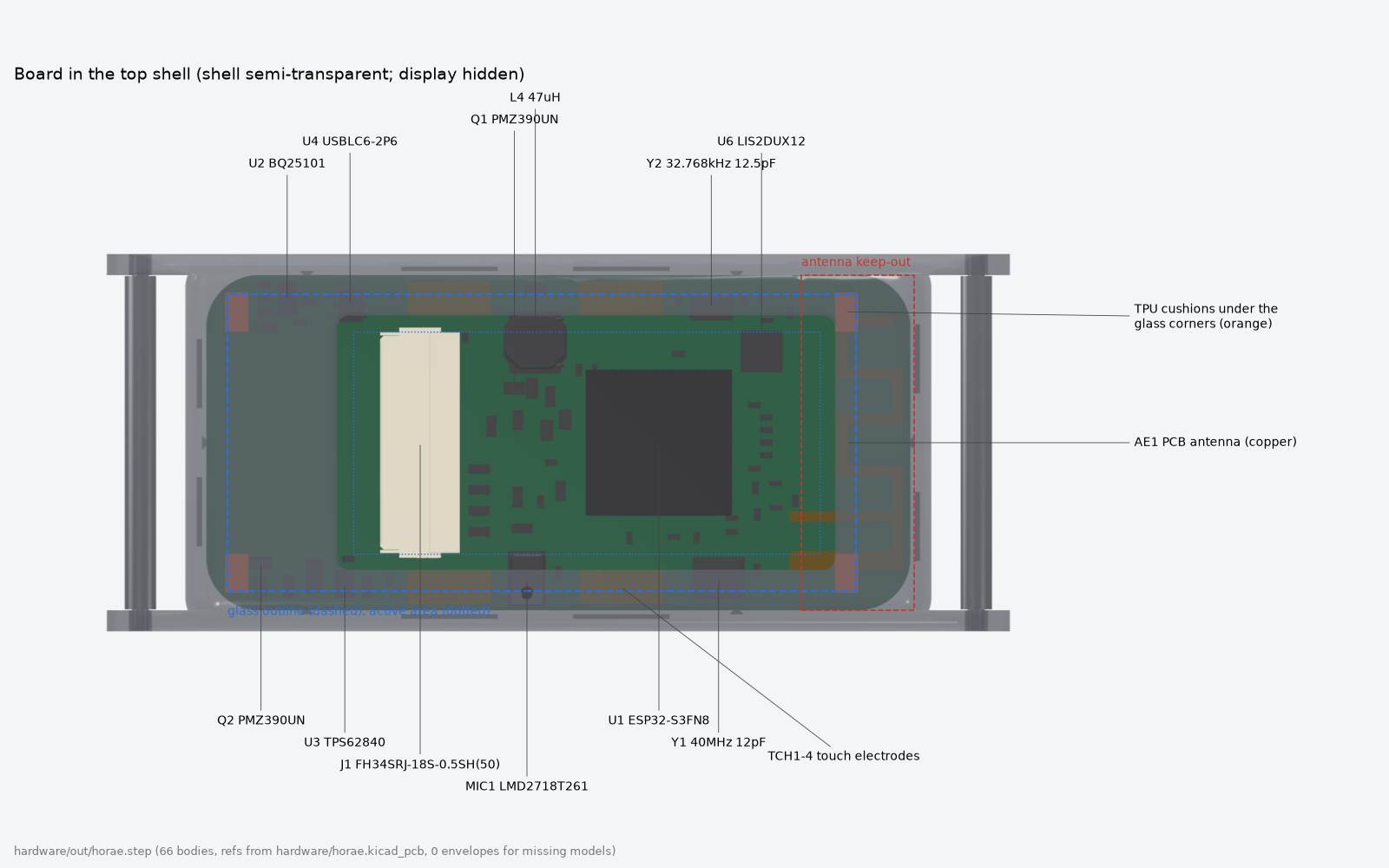
-
A small charging dock, fewer printed parts design
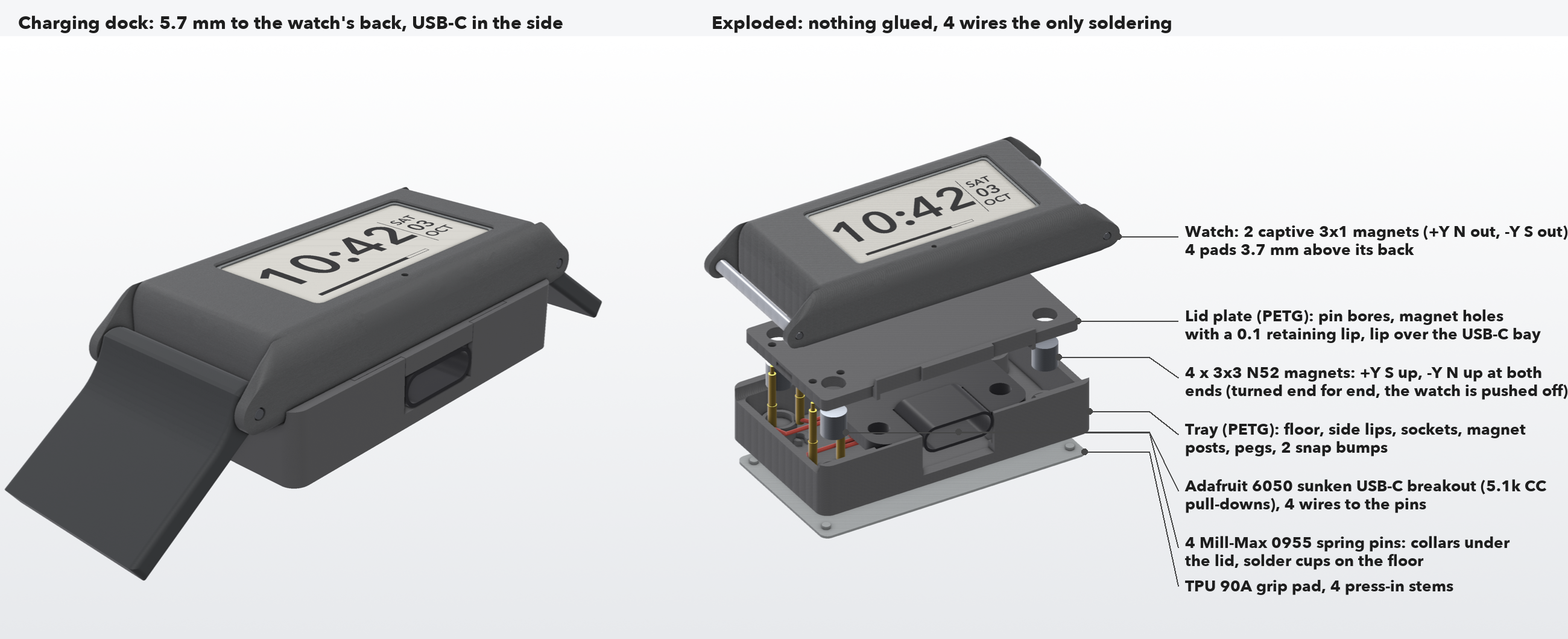
The cut-cable charging head is replaced by a small desk dock, and the print list gets shorter. The watch stays 35.6 × 18.0 × 6.80 mm.
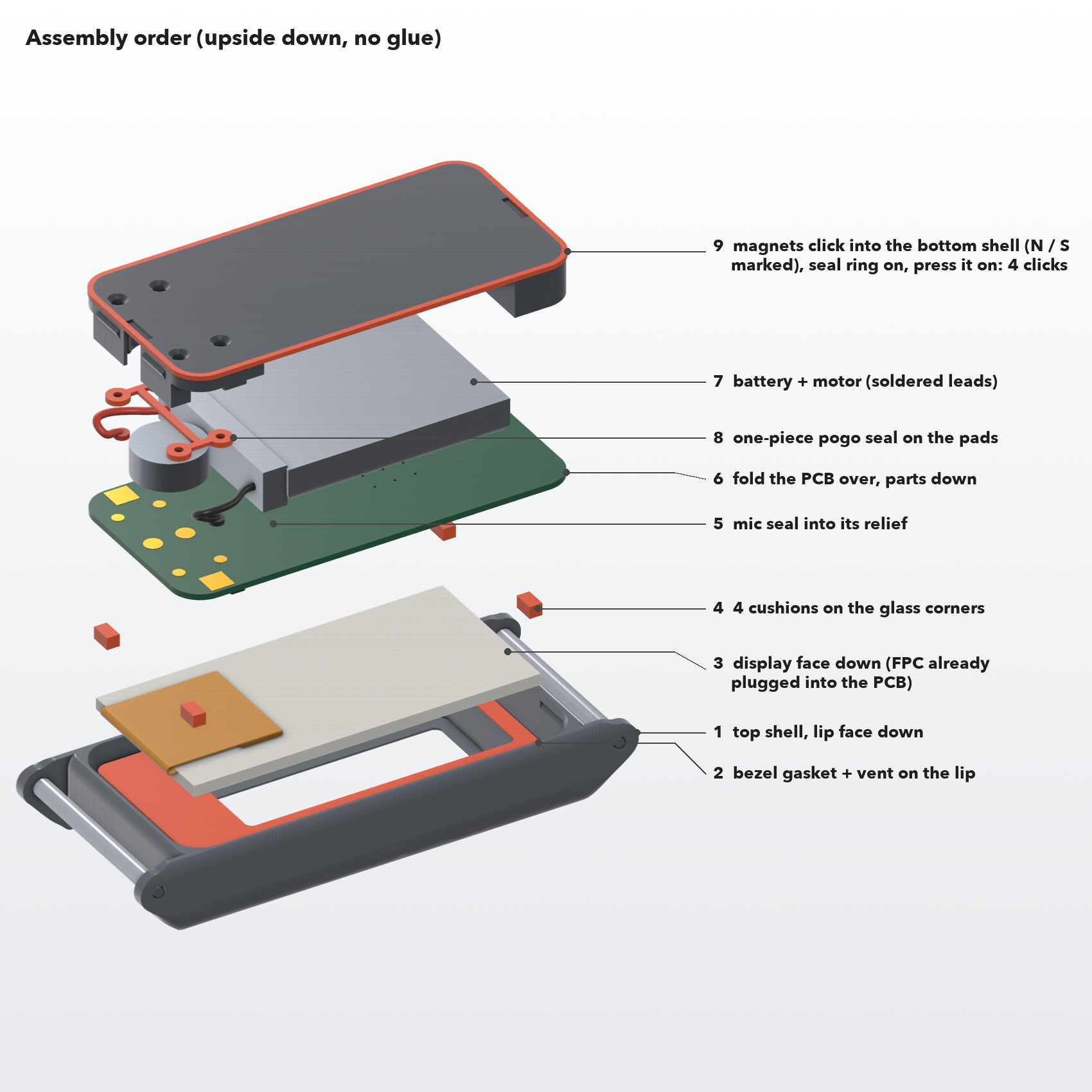
- Charging dock: 35.2 × 20.1 mm, with the watch's back 5.7 mm above the desk. Four Mill-Max spring pins press about 42 g on each pad, and four 3 × 3 mm magnets hold the watch down with 1.9× the pins' push. Put it on end for end and the magnets push it off, so VBUS never touches GND. The watch's own two magnets click in from the inside, behind a 0.1 mm skin of the shell floor, so lifting the watch off can't pull them out. Power comes in through a sunken USB-C breakout (Adafruit 6050) with the CC resistors, so any USB-C charger works, and D+/D− still reach the ESP32 for flashing. The tray and lid snap together; the only soldering is 4 short wires to the pins.
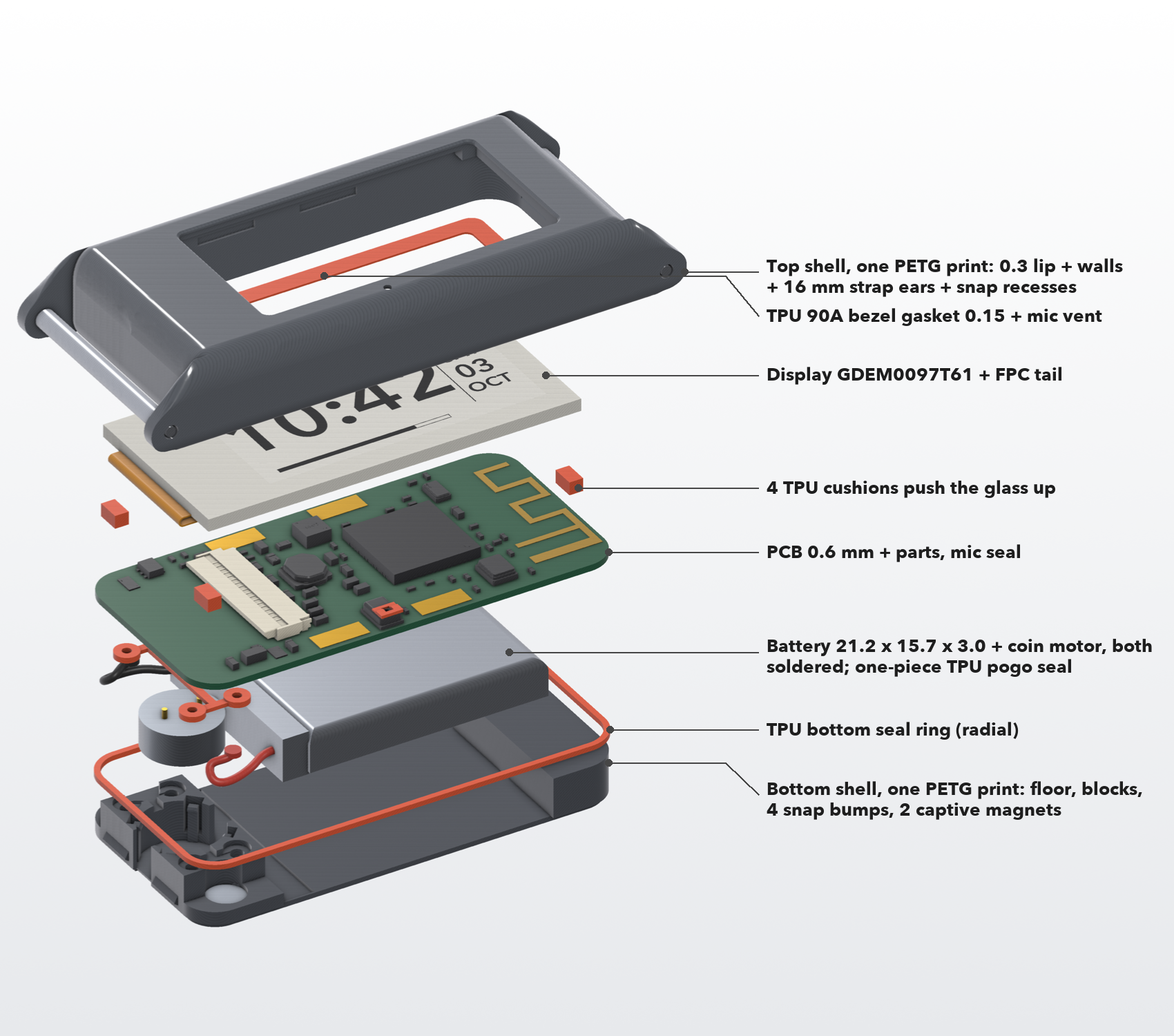
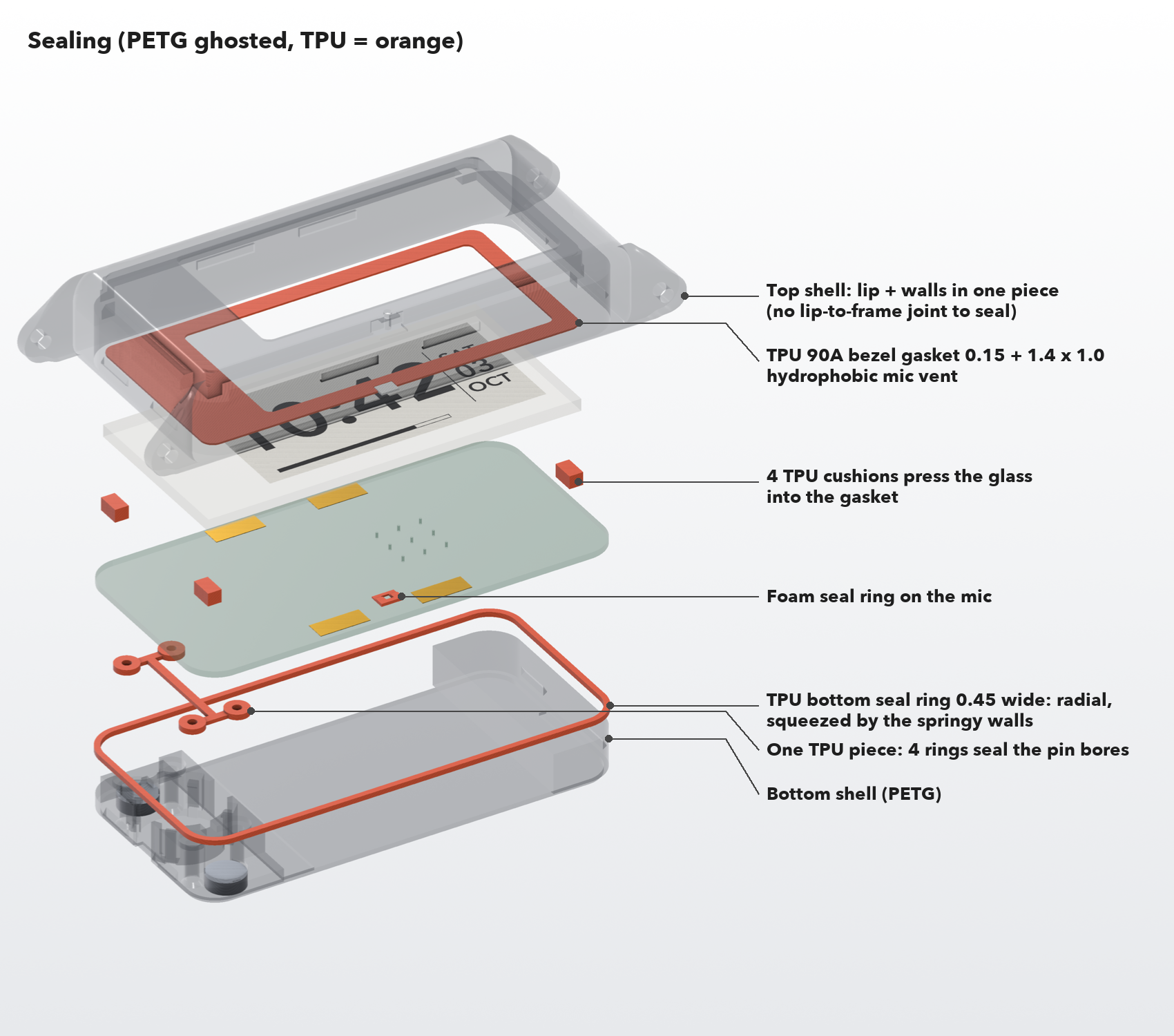
- Fewer printed parts: the motor pad is gone (four sprung fingers in the bottom shell hold the motor still), the four charging-pad seals are one piece, and the carbon-fibre version has 2 touch windows instead of 4. A watch is now 10 printed pieces instead of 14 (13 instead of 19 in carbon fibre). The glass cushions, mic seal, bezel gasket and shell seal stay separate: joining them would cross board parts, the antenna, or a gap too thin to print.
- Two print jobs: ready-made A1 mini plates, one PETG (both shells plus the dock's tray and lid) and one TPU (every soft part plus the dock's grip pad). The carbon-fibre version takes 3.
- Battery wires: cells this size come with two bare wire leads and no plug, so the model now has real 0.6 mm wires in a channel with room for a slack loop: red to +, black to −.
- 3D explorer: the dock is in the explorer at the top of the page. Switch it on with Dock and pull it apart.
-
Two shells that click together, ears that grow out of the case design
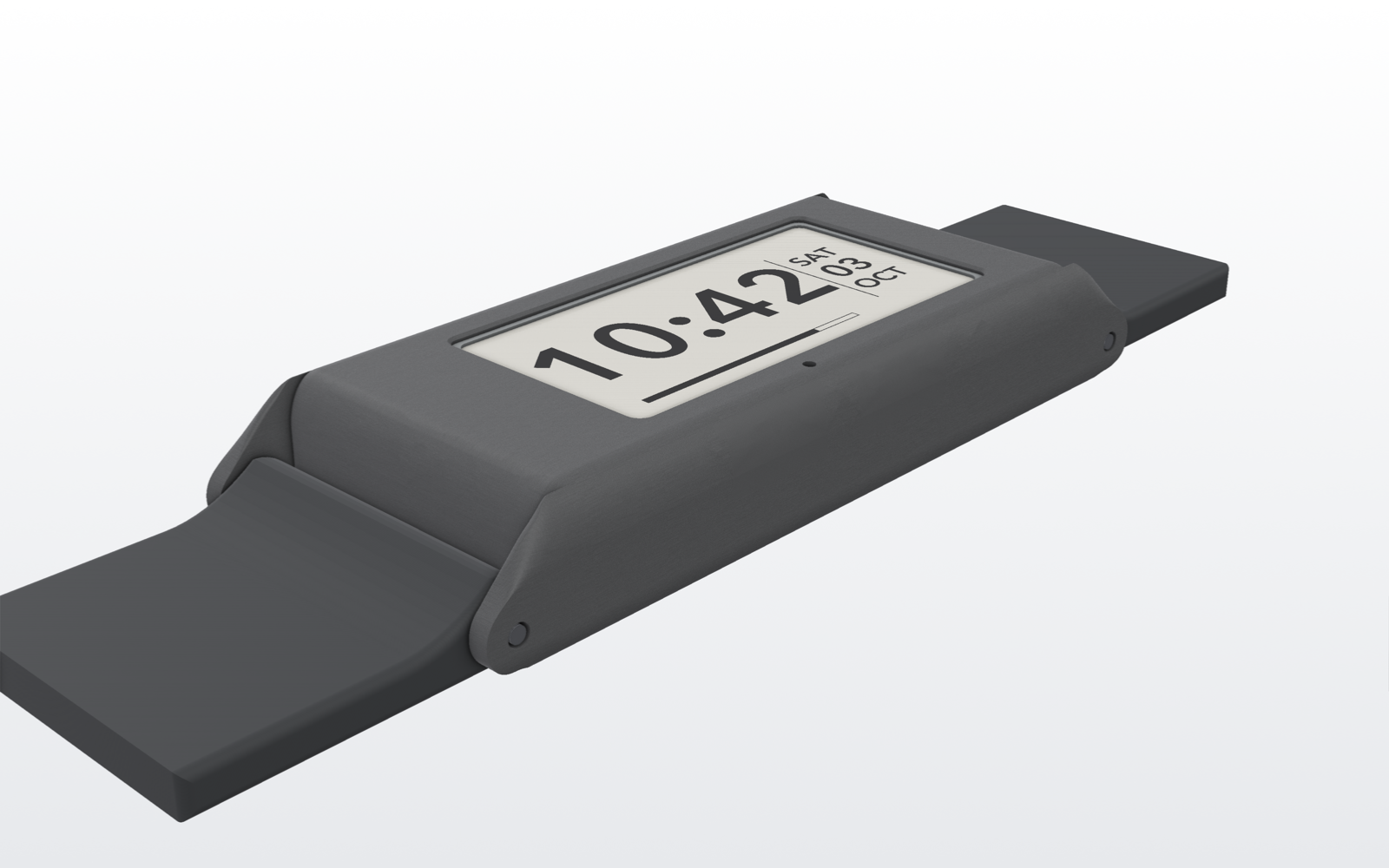
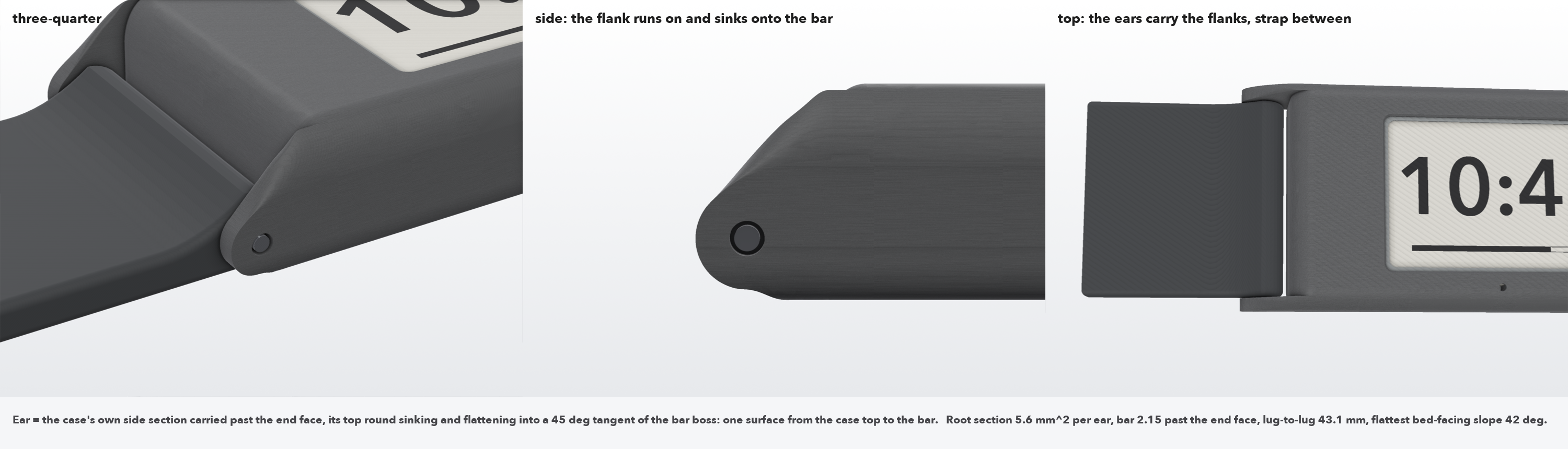
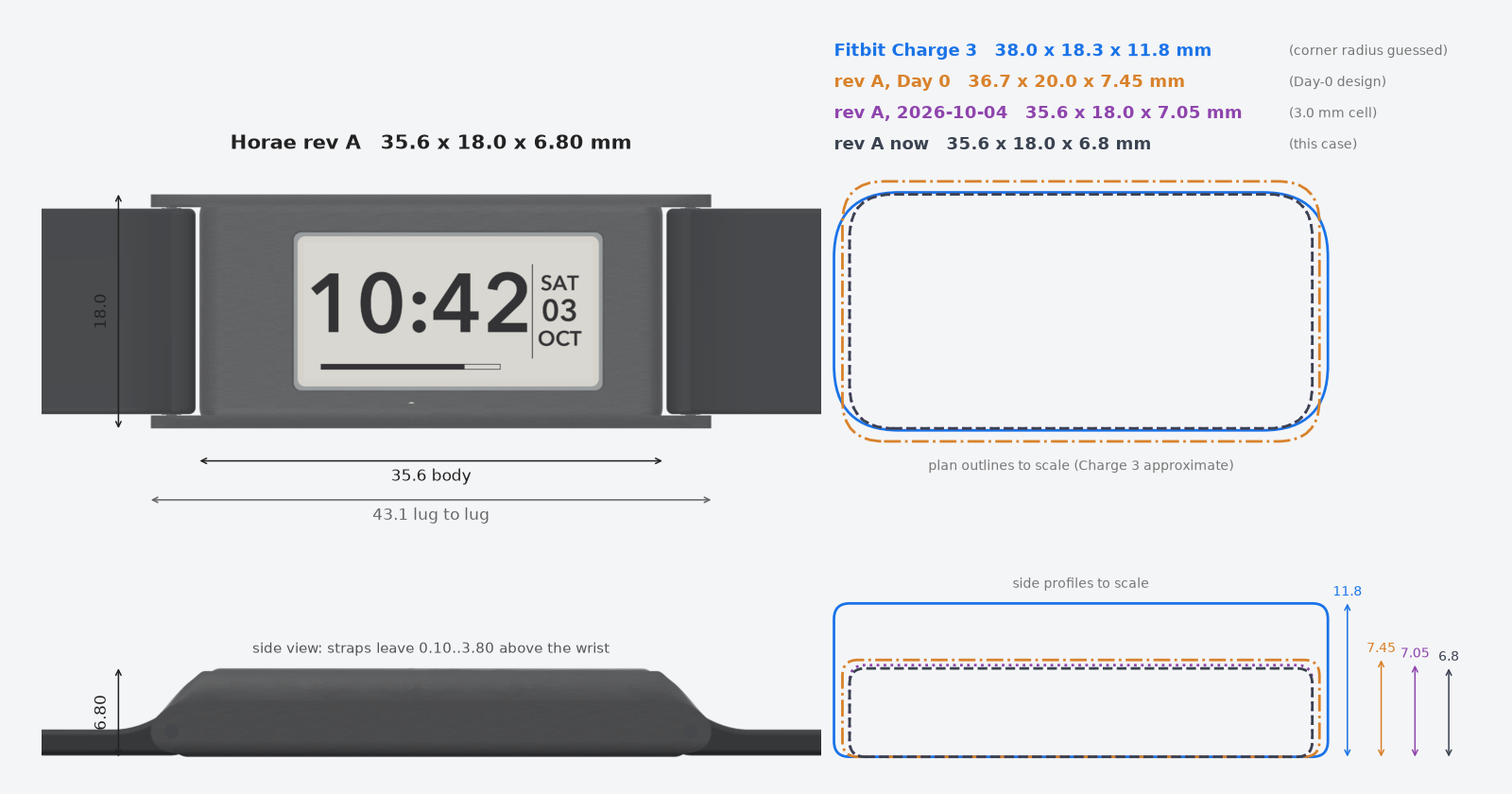
A round driven by review feedback: the strap lugs looked like an afterthought, the gaskets would have needed glue, and the dock was one more thing to print. The case is now 35.6 × 18.0 × 6.80 mm.
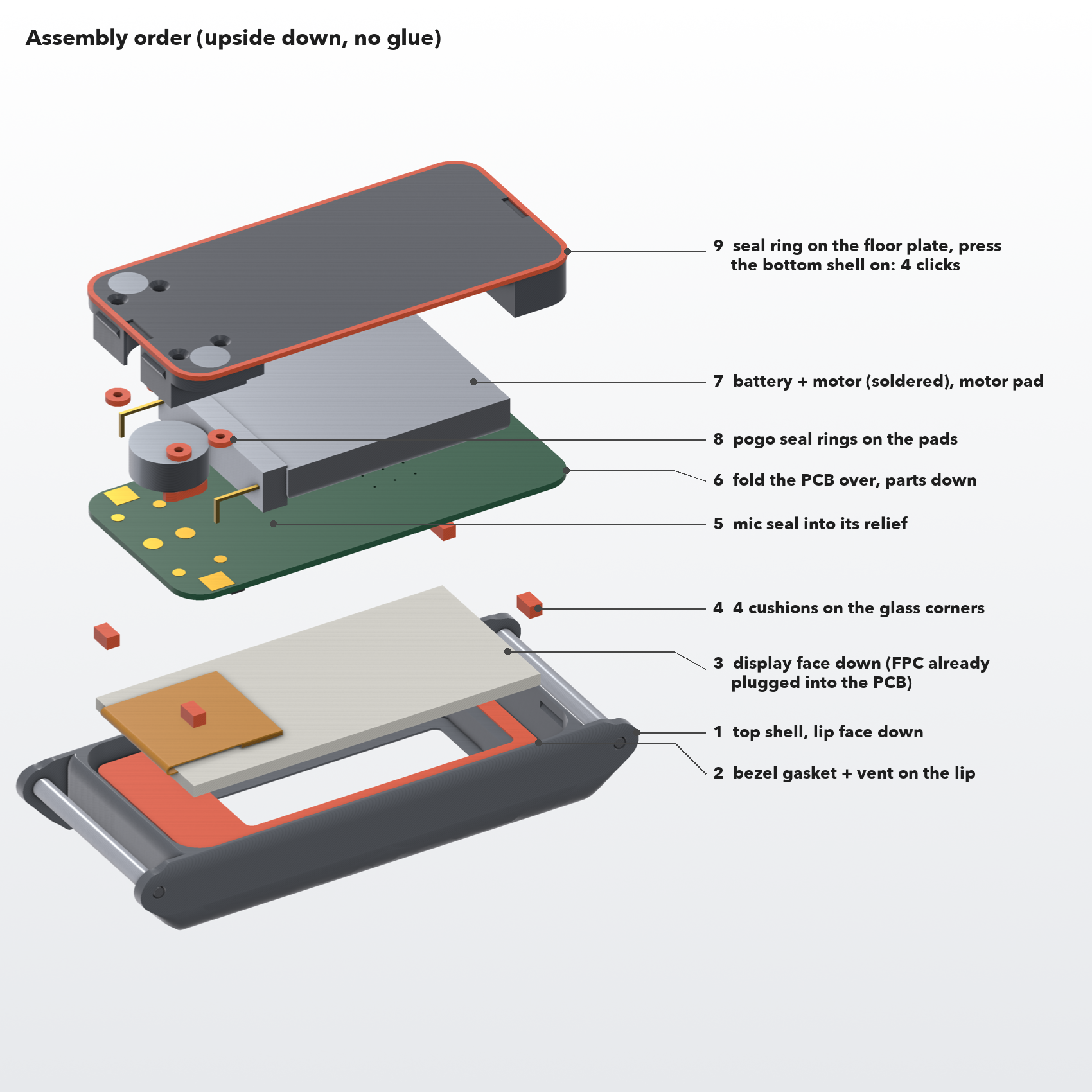
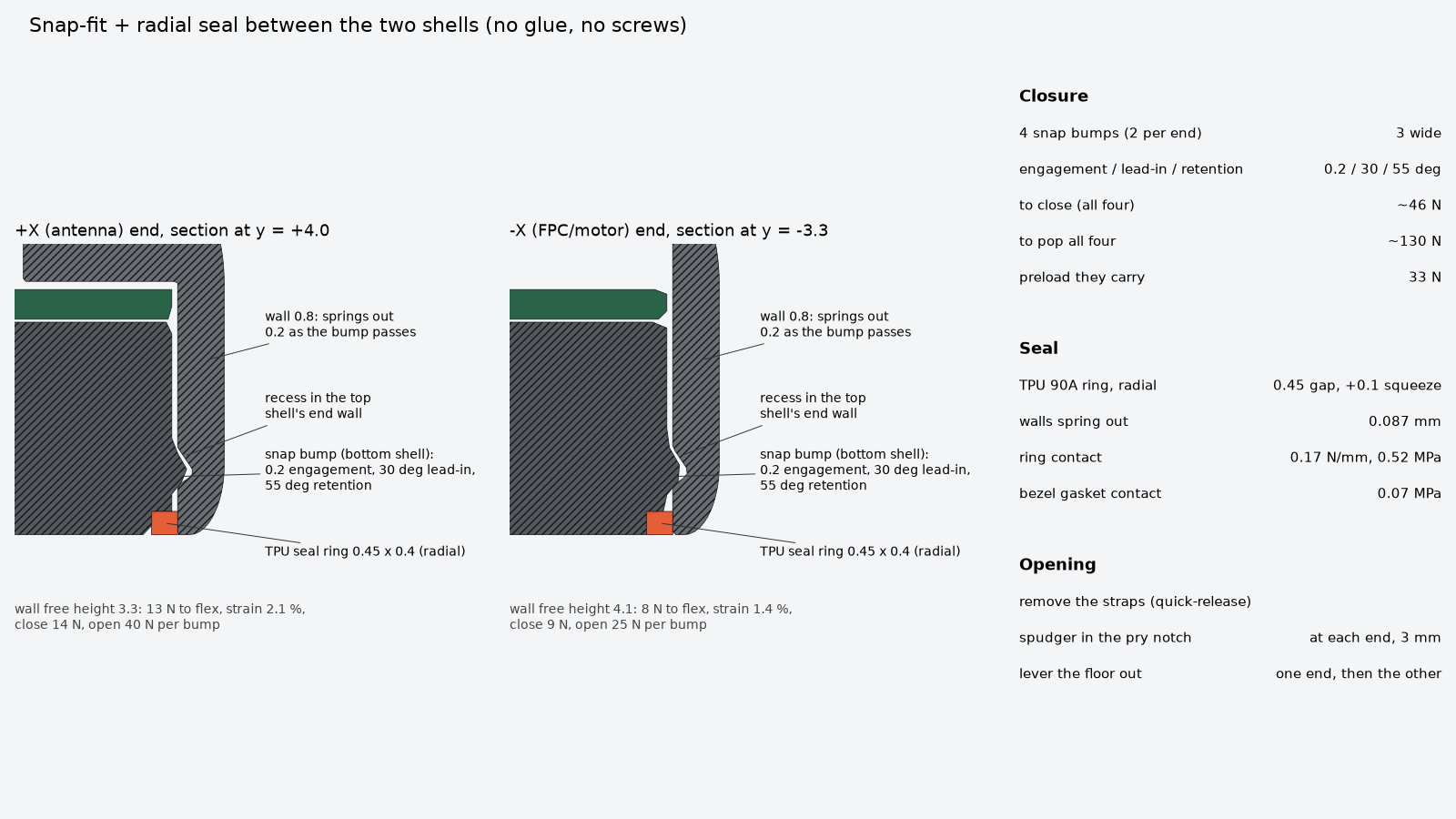
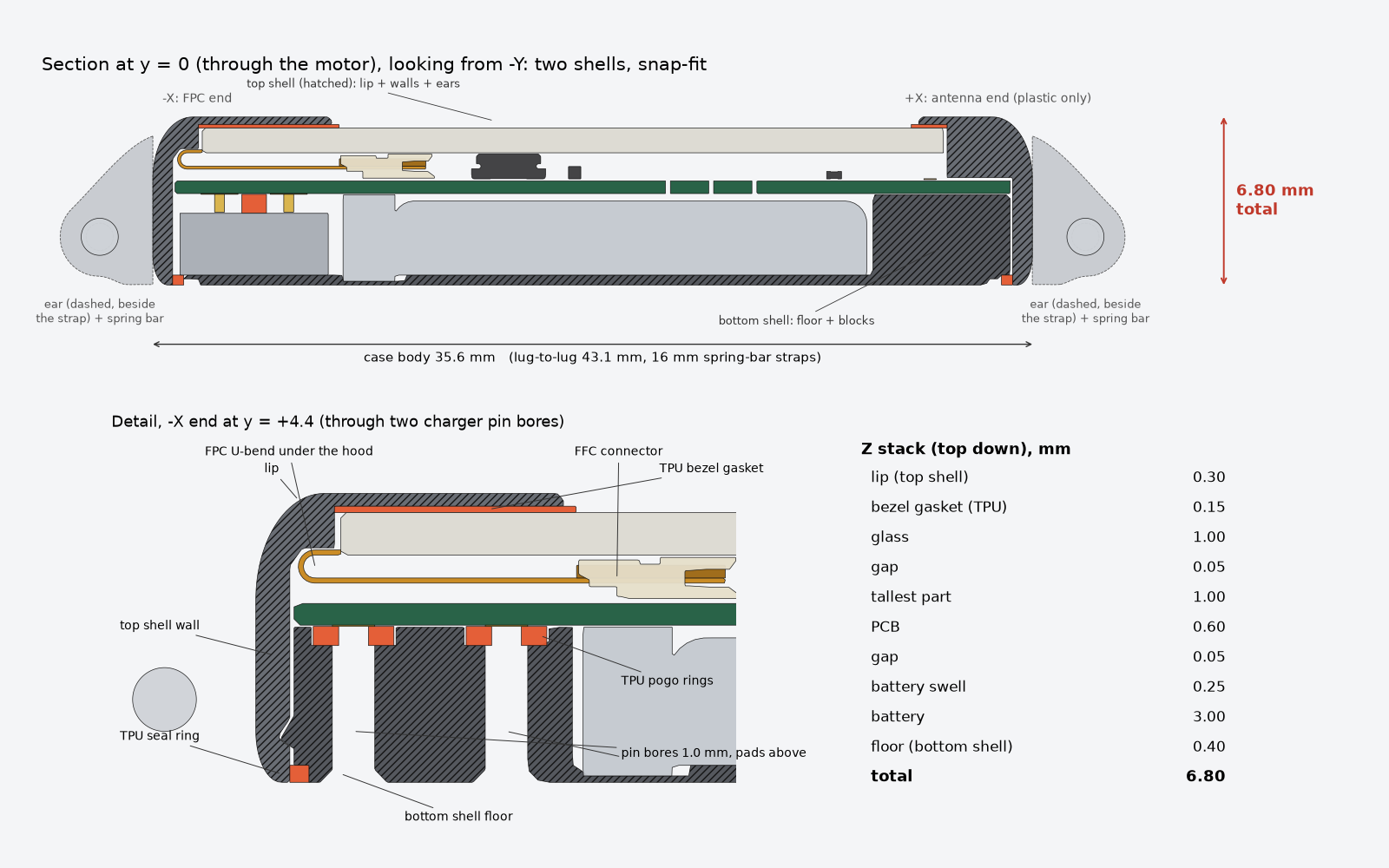
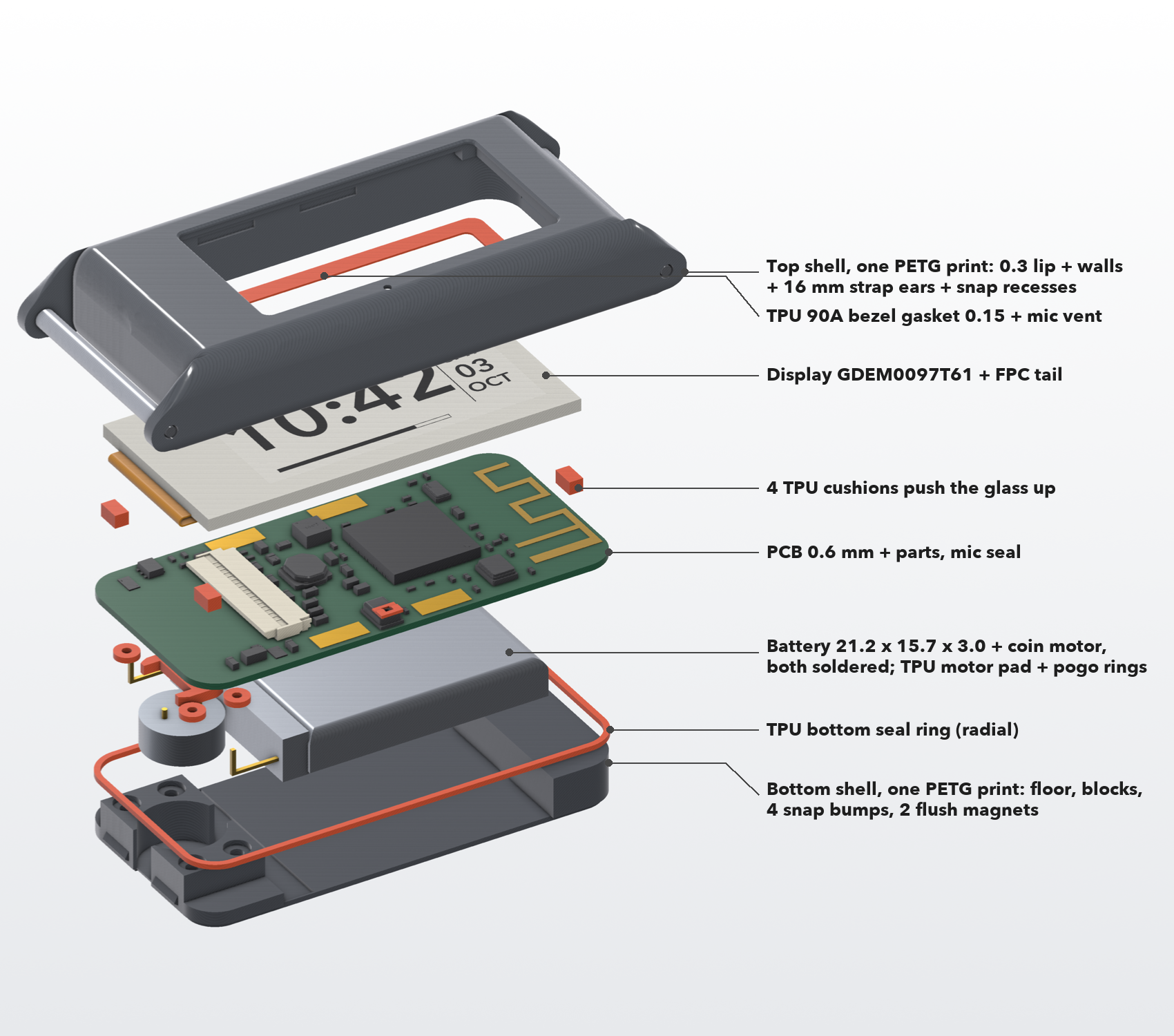
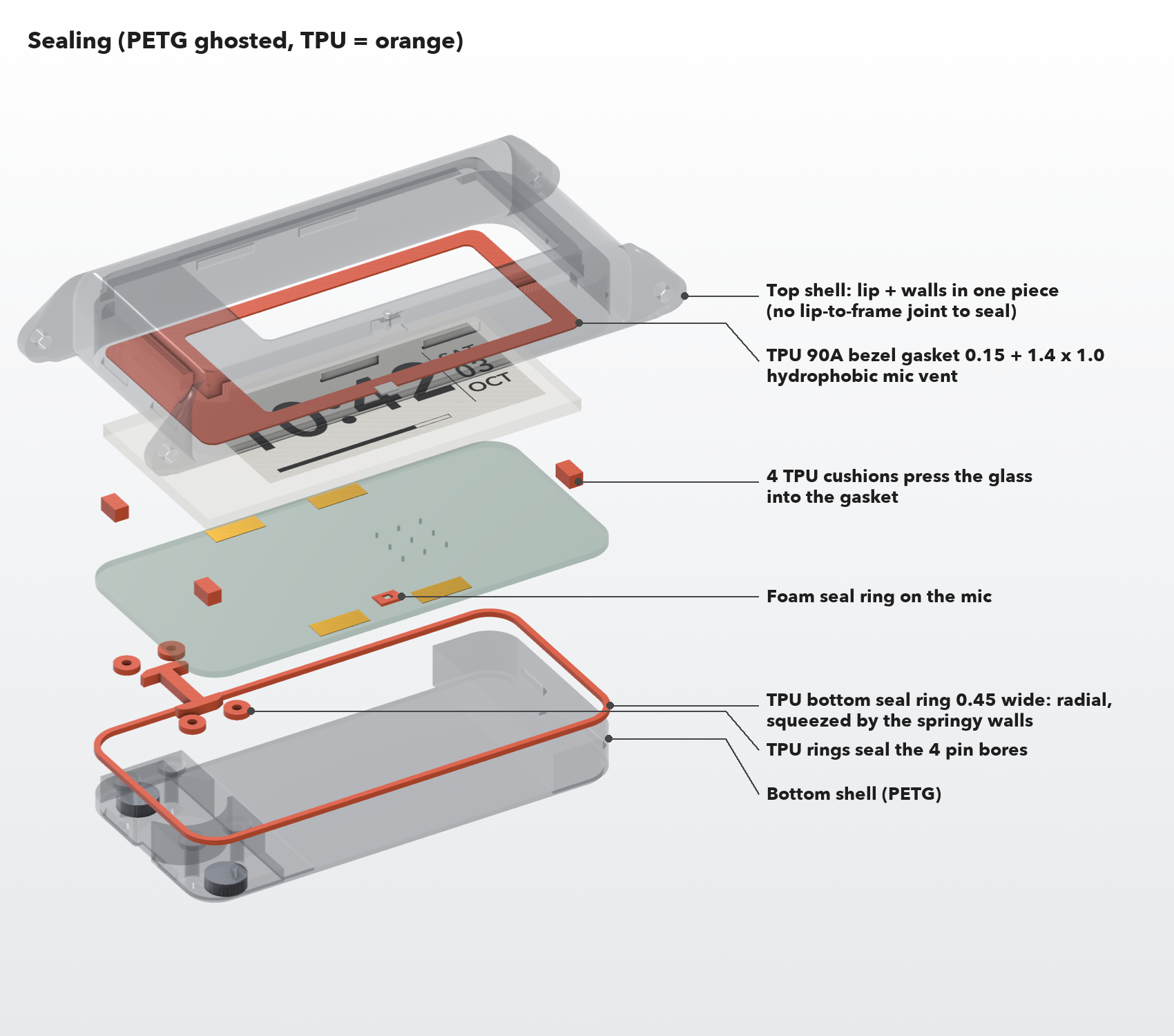
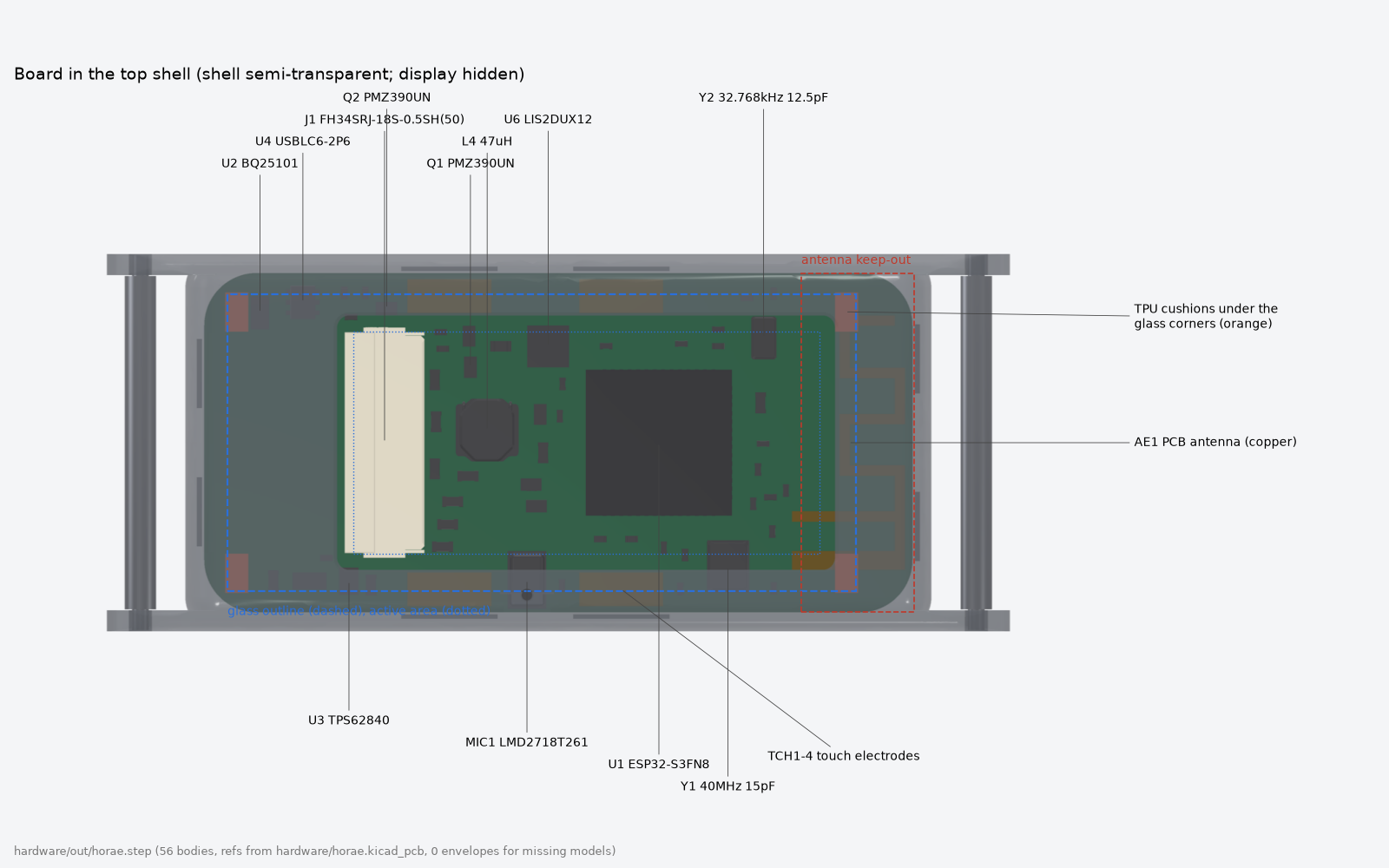
- No glue, no screws: two PETG shells click together on 4 snap bumps (about 46 N to close, 130 N to open with a spudger in the end notch). A TPU 90A ring between them seals sideways. Every soft part (bezel gasket, glass corner cushions, pogo seals, motor pad, mic seal) is held in place by the closed case. So are the carbon-fibre version's plain-PETG antenna and touch windows.
- Strap ears: each ear is the case's own side profile carried past the end, sloping down onto the spring bar: one surface from the top of the case to the bar. The root section is 1.6× bigger and about 2.5× stronger in bending. Still standard 16 mm spring bars, 43.1 mm lug to lug.
- Thinner: a 0.3 mm bezel lip, a 0.15 mm gasket and a 0.4 mm floor take 0.25 mm off, with no change to the electronics.
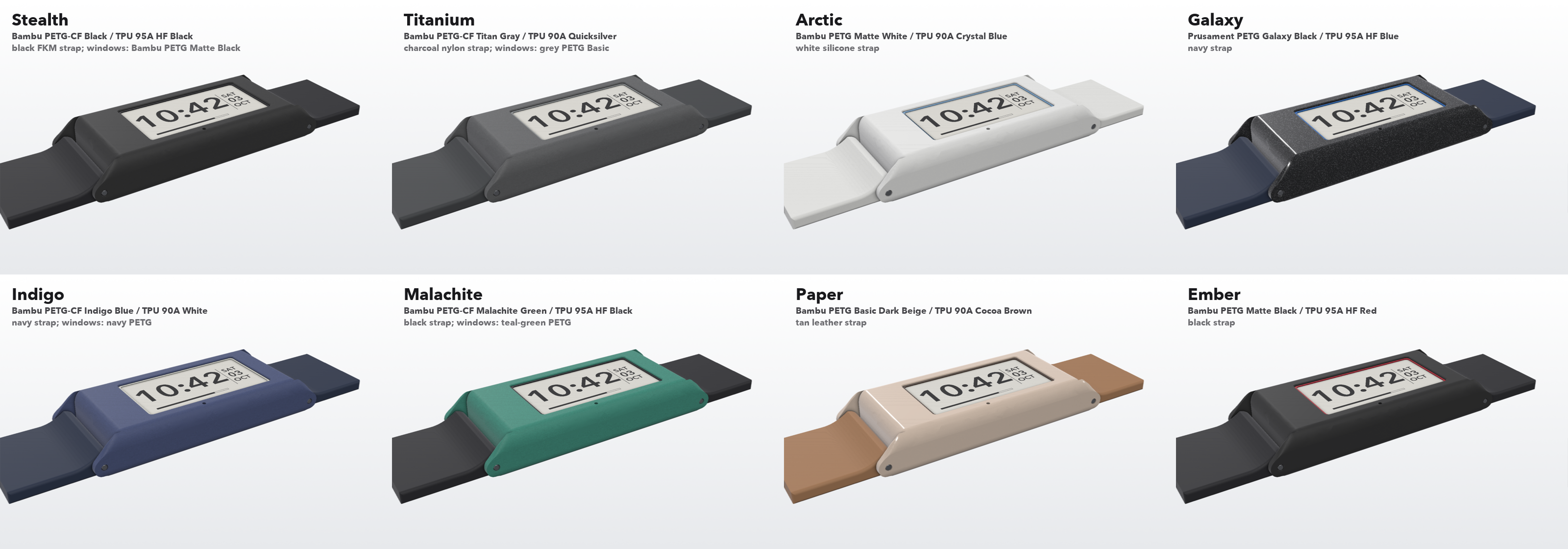
- Colours: 8 colourways in real filaments sold in Canada: Bambu PETG-CF (Black, Titan Gray, Indigo Blue, Malachite Green), PETG Matte, PETG Basic and Prusament Galaxy Black, with TPU 90A/95A accent rings. The renders now use the filaments' real colours and finishes.
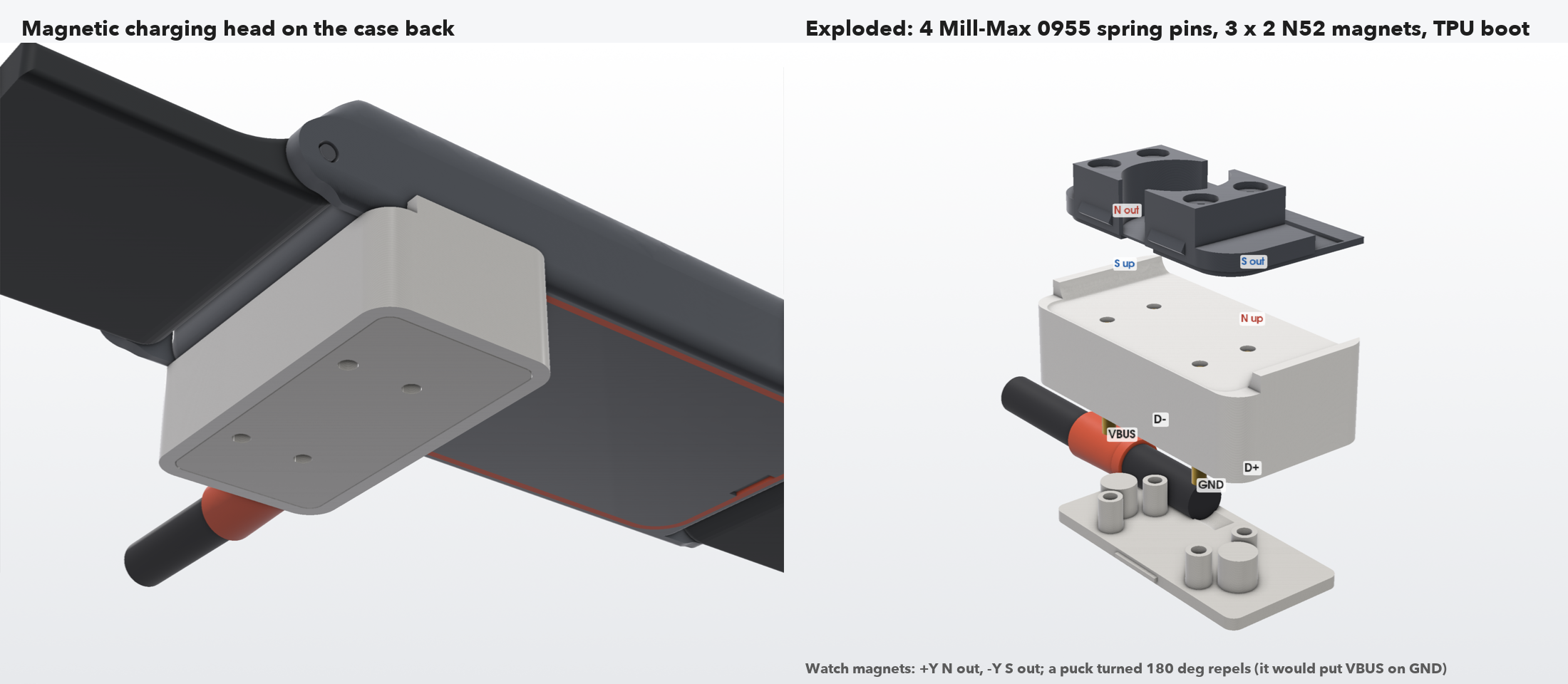
- Charging: the dock is gone. A small magnetic cable head snaps onto the back, with 4 Mill-Max spring pins and 2 polarity-keyed magnets. Turned 180° it repels instead of shorting VBUS to ground. The magnets hold with twice the pins' spring force, and the head's two halves click together around the pins and a cut USB cable.
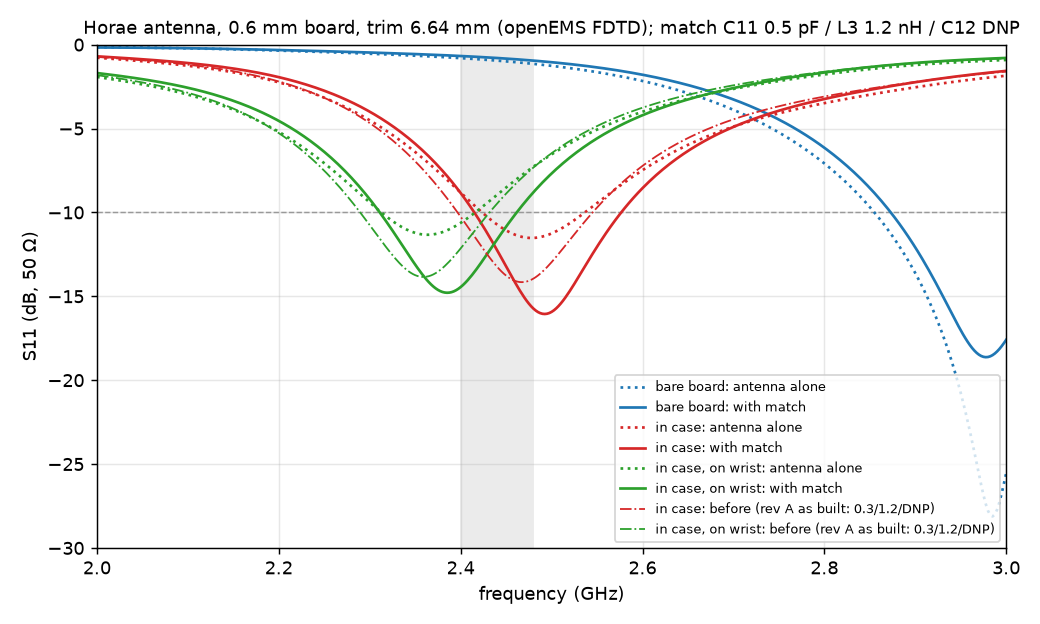
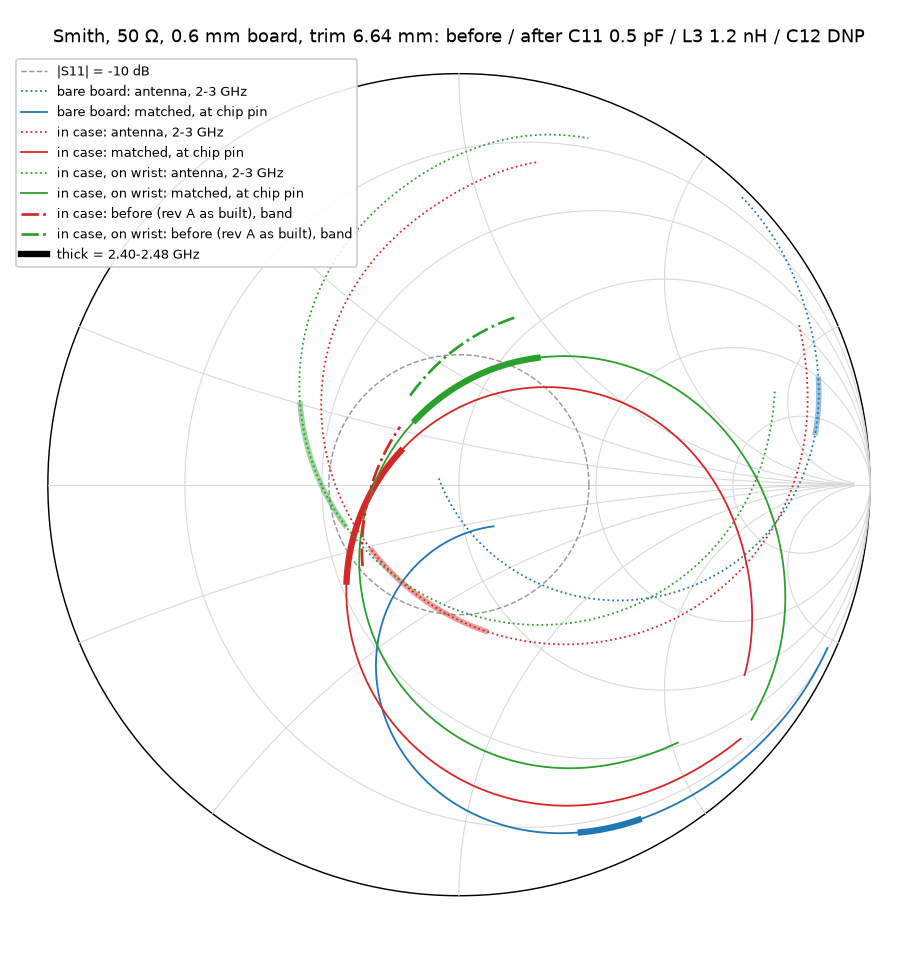
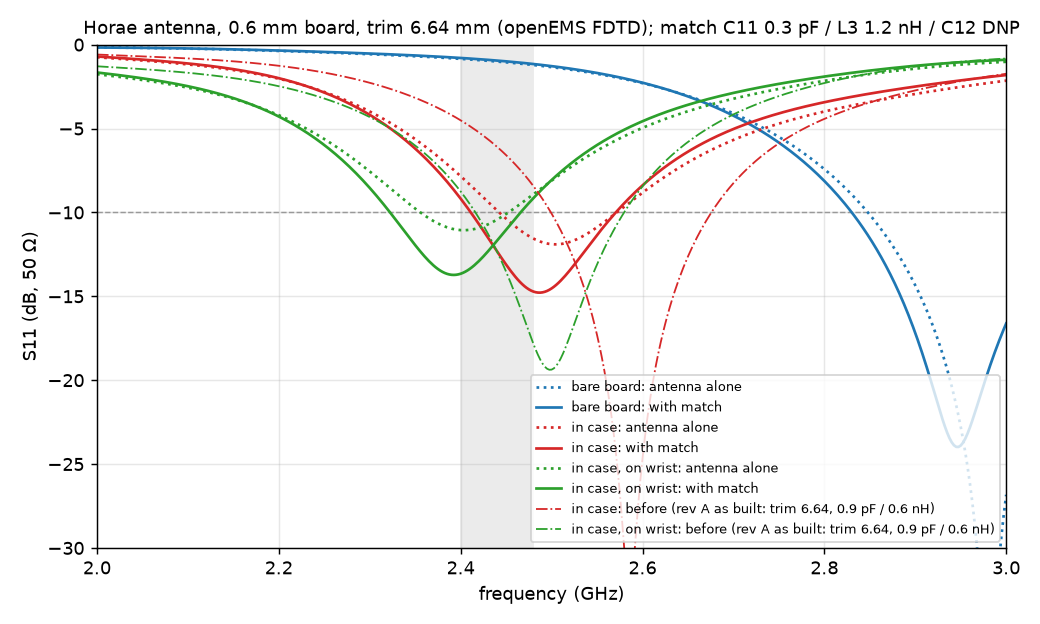
- Antenna: re-checked against the new shells, now modelled straight from the CAD solids. The extra plastic around the antenna end pulled the resonance down about 1%, so one capacitor changes (0.3 → 0.5 pF): −9 to −16 dB across the 2.4 GHz band in the case and −9 to −14 dB on the wrist.
-
Rev A, slimmer: smaller than a Charge 3 design
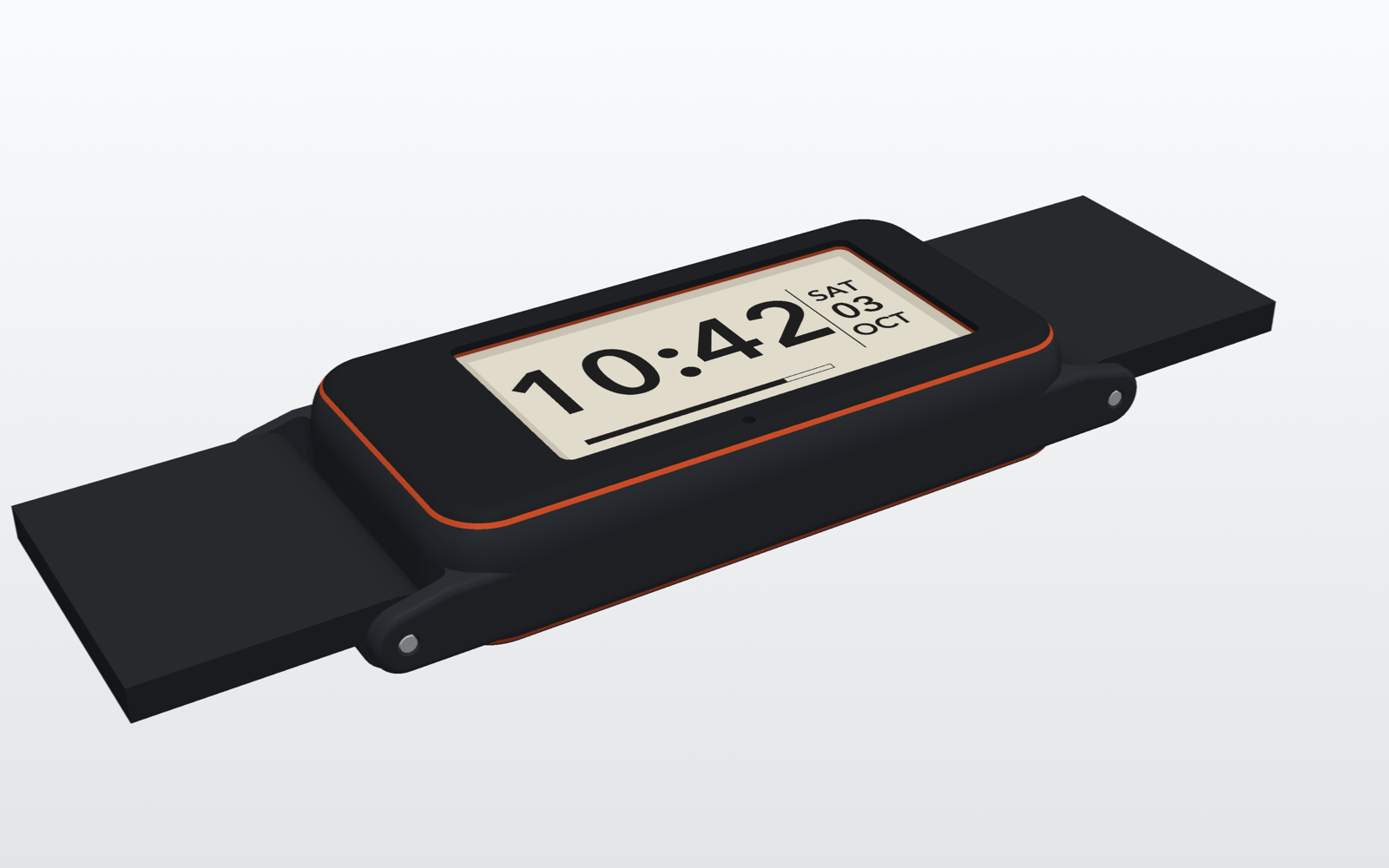
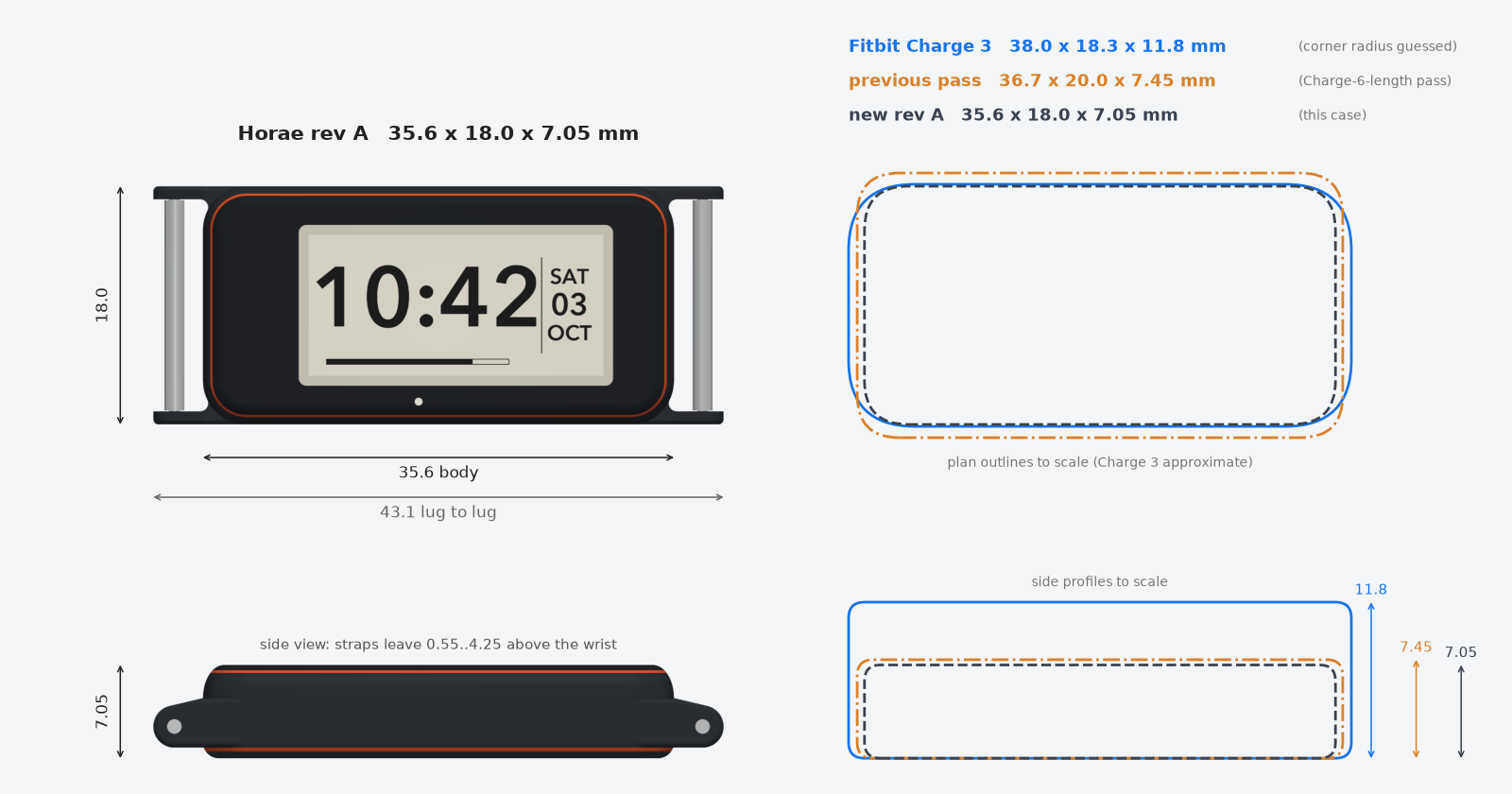
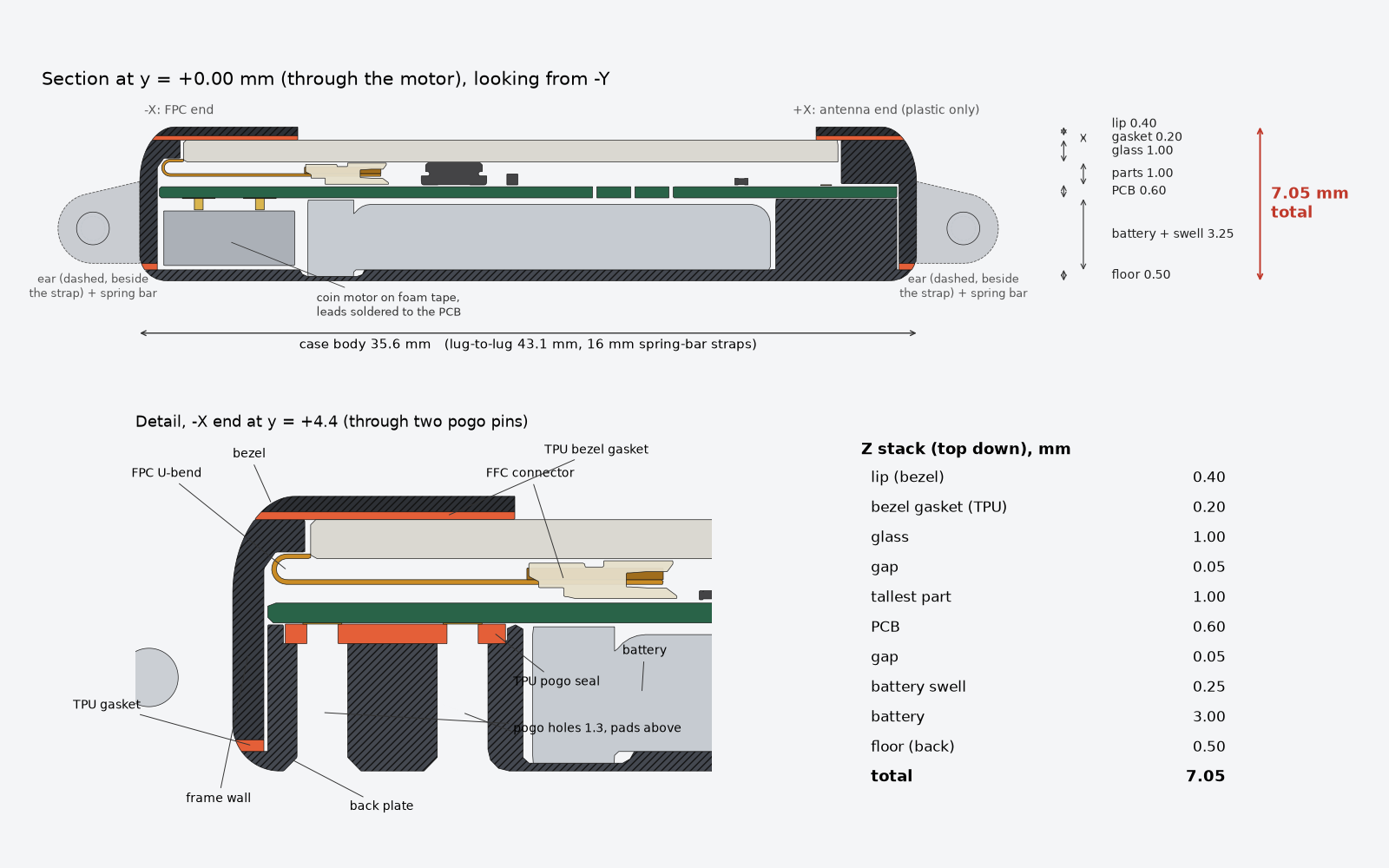
A full review and an "optimize everything" pass, borrowing ideas from Pebble 2, Watchy v3 and Yatchy. The watch is now 35.6 × 18.0 × 7.05 mm: smaller than a Fitbit Charge 3 (38 × 18.3 × 11.8) in every direction, and 40% thinner. Day 0 was 40.5 × 18.5 × 7.15; an interim pass capped at the Charge 6 length was 36.7 × 20.0 × 7.45.
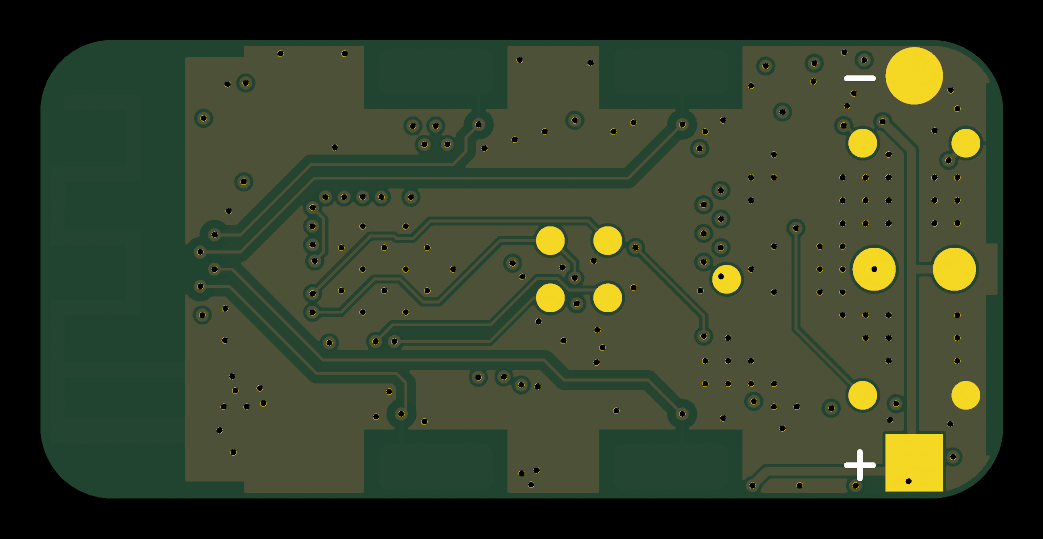
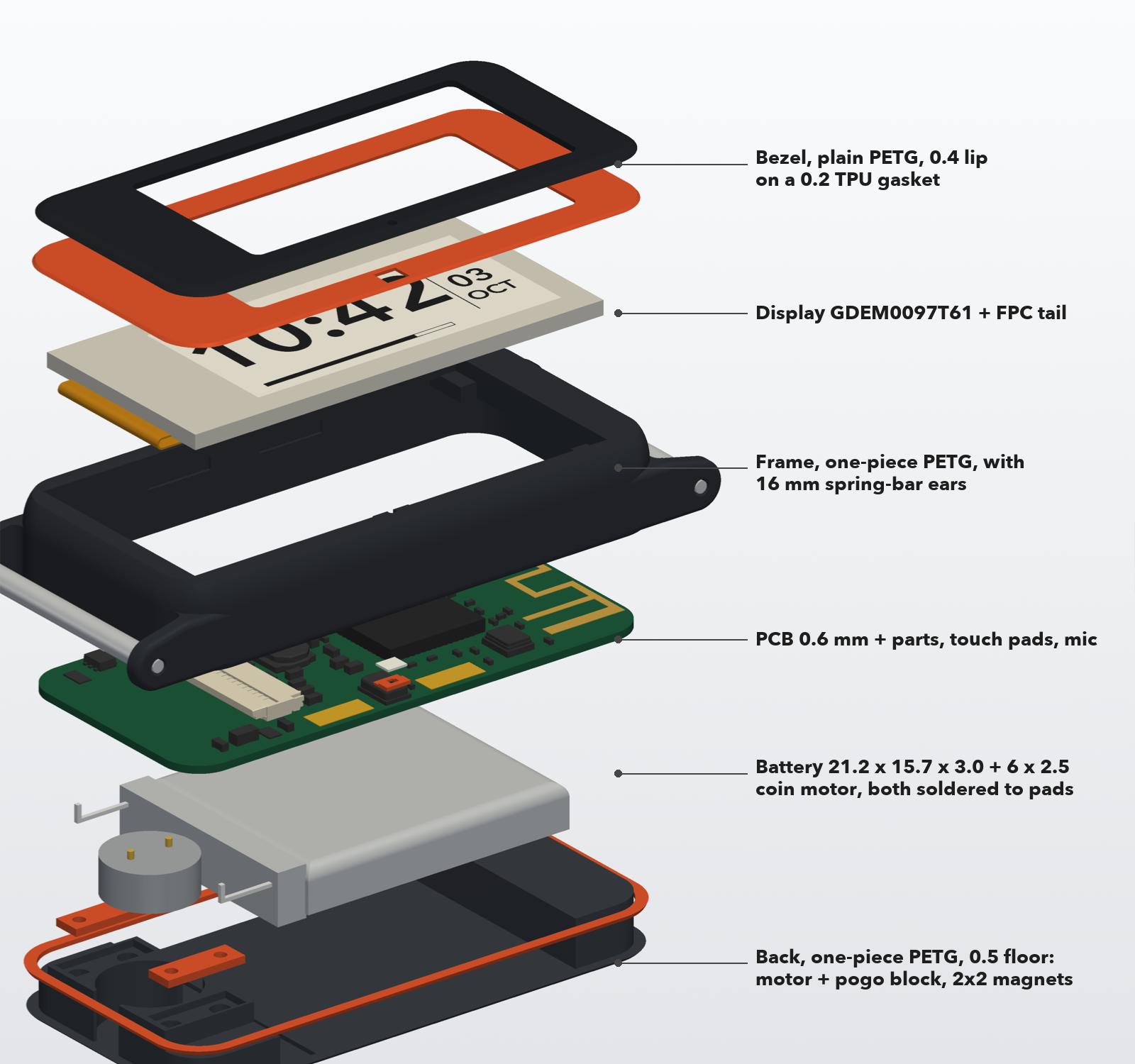
- Board: 33.8 × 16.2 × 0.6 mm, 4 layers, routed and DRC-clean with 0 warnings. The tallest part is now 1.0 mm, down from 1.2.
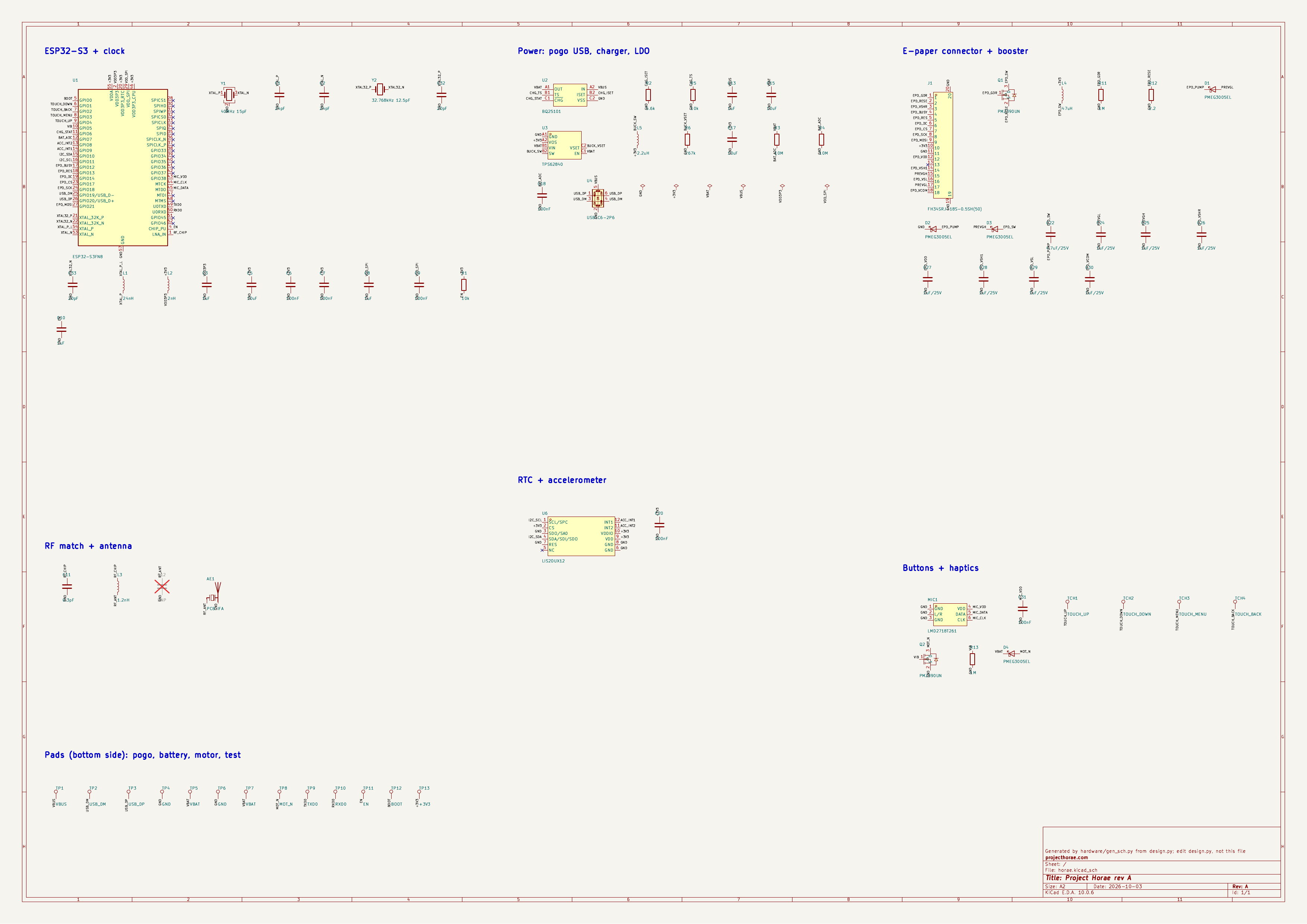
- The RTC chip is gone: a 32 kHz crystal runs the ESP32's own clock, as on Watchy v3 and Yatchy, saving $3.44.
- The charger is now a TI BQ25101 (75 nA drain, 28 V-tolerant input) and the regulator a TI TPS62840 buck (60 nA quiescent), replacing a 2 µA LDO.
- The e-paper booster now uses Solomon's reference values in 1.0 × 0.6 mm packages.
- The display and I²C lines are on low-power GPIOs, so the ULP core can redraw the minutes without waking the main CPU (Yatchy's trick).
- Case: the strap lugs were rendering detached from the body; they are now one piece with the side walls. Standard 16 mm spring-bar straps, 43.1 mm lug to lug. Still single-filament PETG with TPU gaskets, plus an optional 6.55 mm version for a 2.5 mm cell.
- Corrections from the review:
- JLC's cheap "Economic" assembly can't place 0201 parts, so this board needs Standard assembly. Two assembled boards come to about USD 165–180 before shipping and tax, not 120–130.
- Real batteries for this pocket hold 40–55 mAh, not ~100. That's still about 5–7 weeks with good firmware.
- No 6 mm vibration motor with spring contacts exists, so the battery and motor take 4 solder joints.
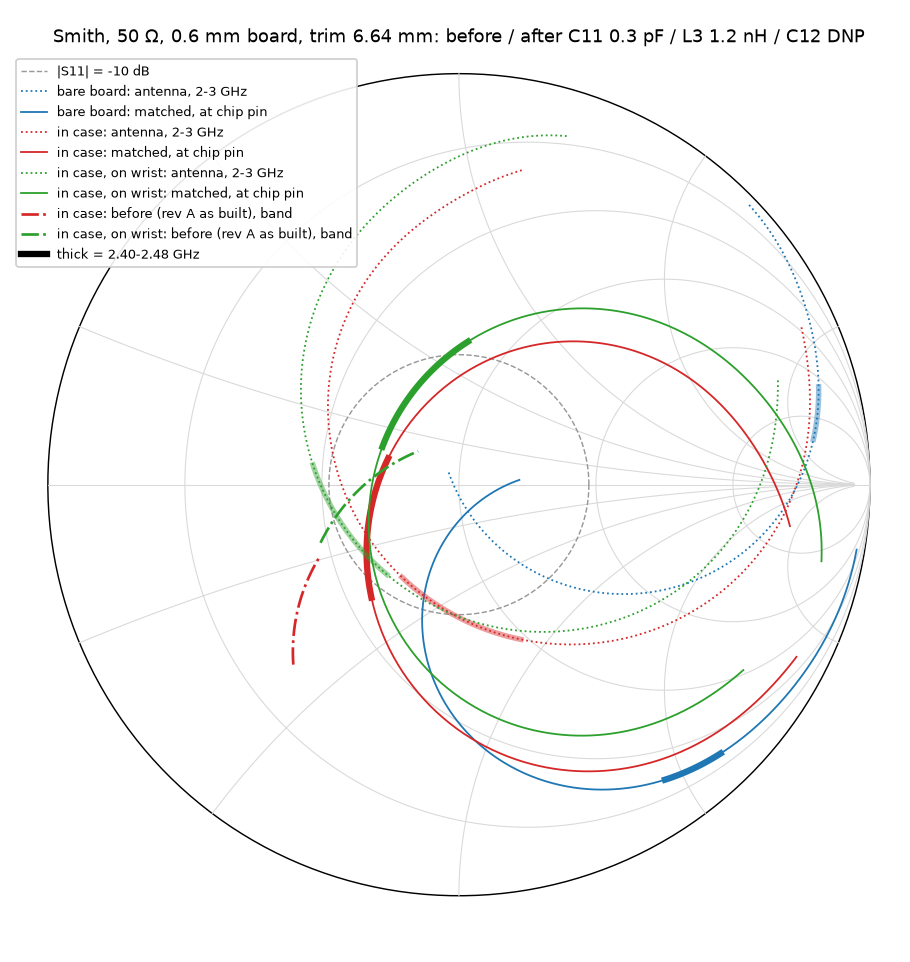
- Antenna: re-simulated in openEMS with the new 0.6 mm board, the slim case, both steel spring bars and the strap. Watchy's trimmed antenna stays as is; a new match (0.3 pF / 1.2 nH) gives −9 to −15 dB across the 2.4 GHz band in the case and −9 to −14 dB on the wrist. The simulation also caught a script bug: the ground pours on three layers had stopped 7.5 mm short of the antenna. Fixed.
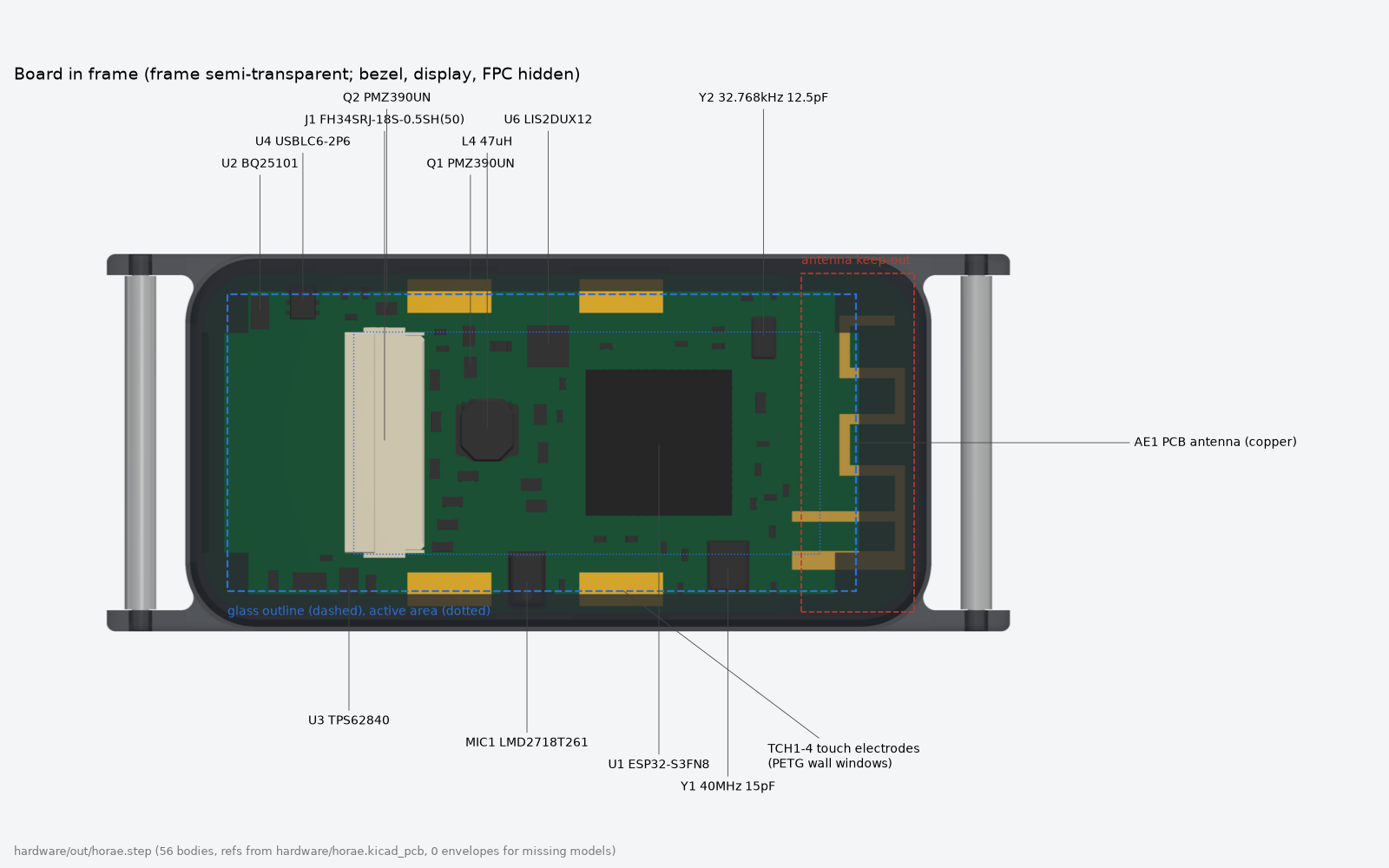
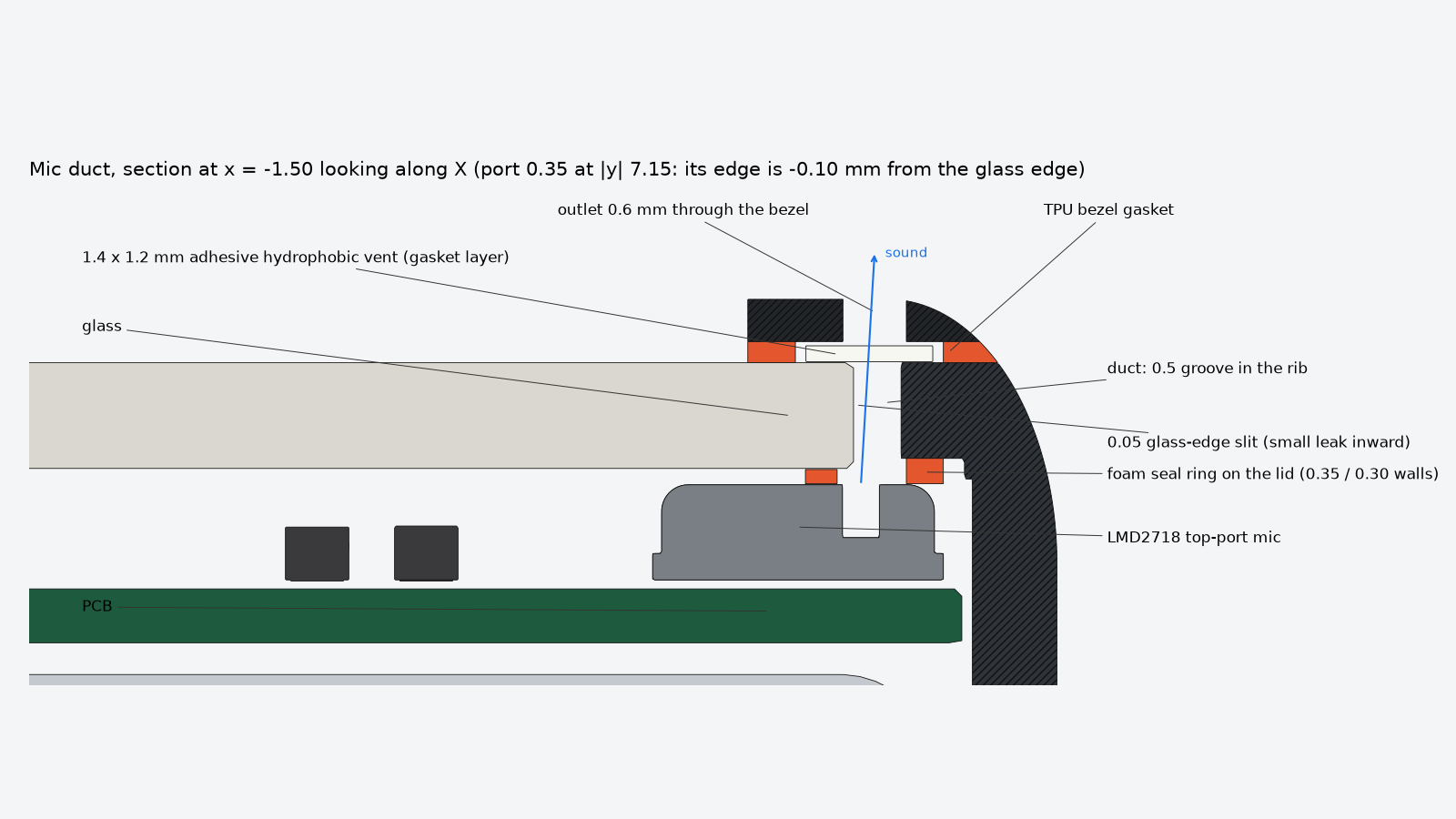
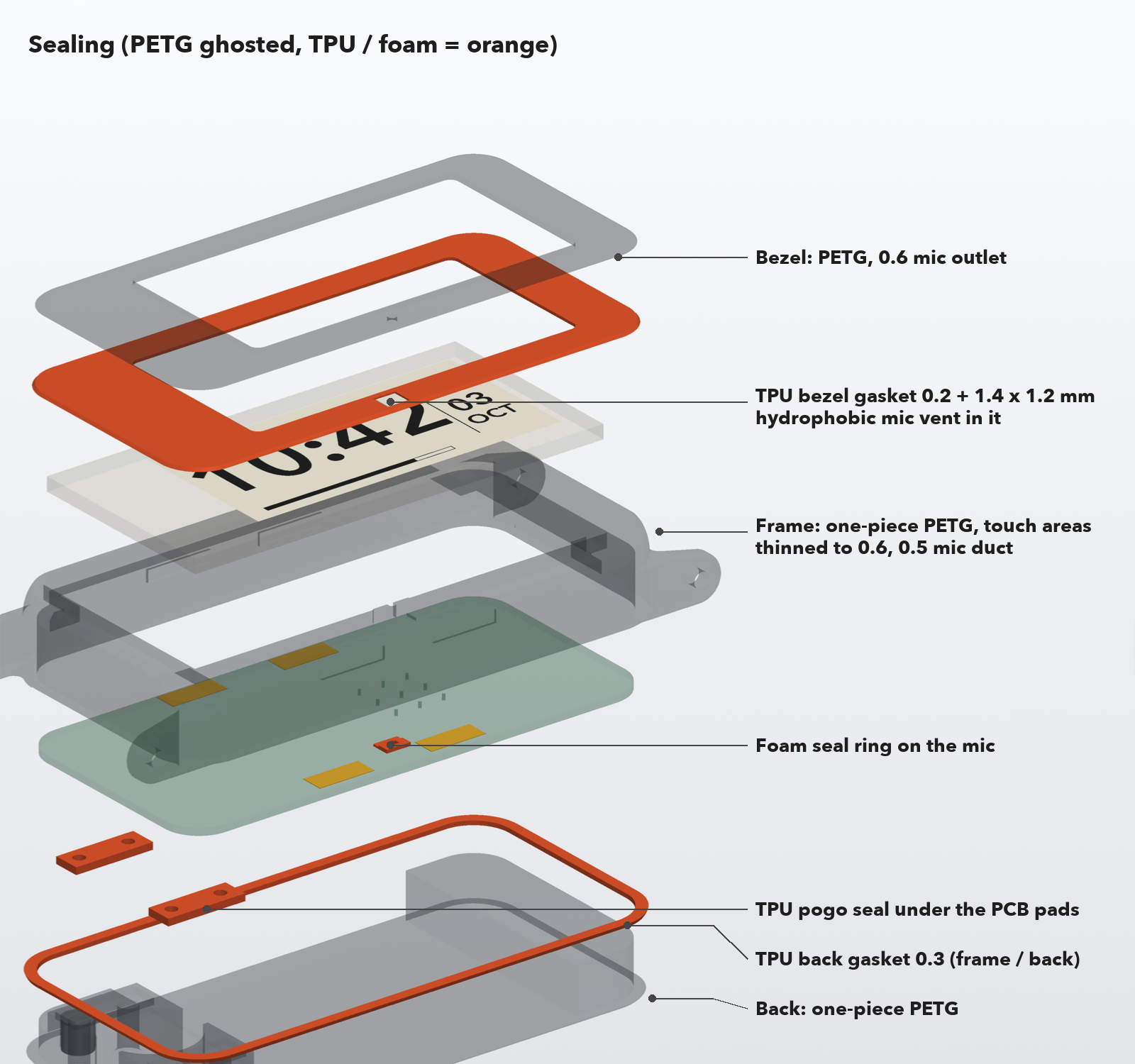
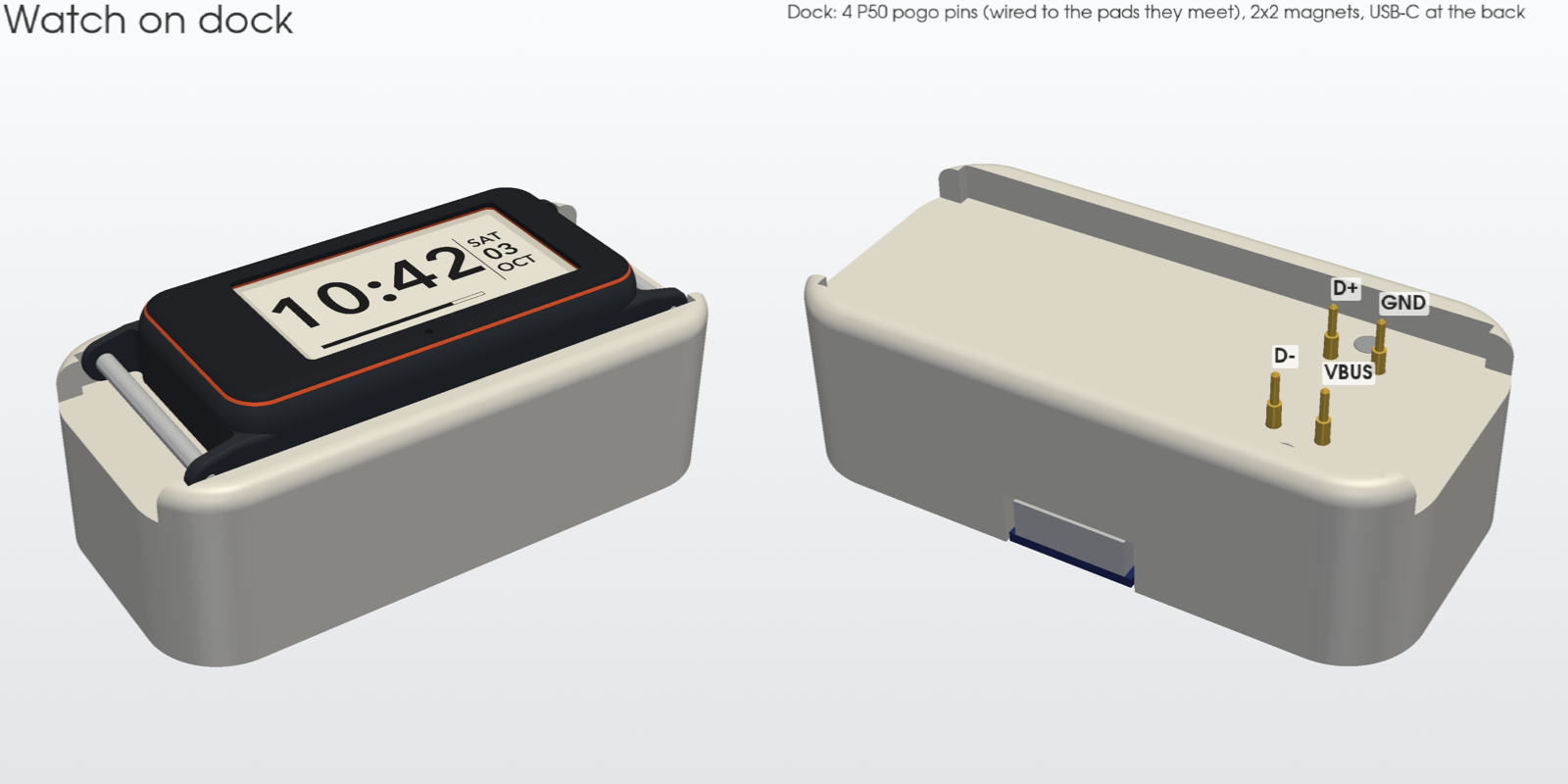
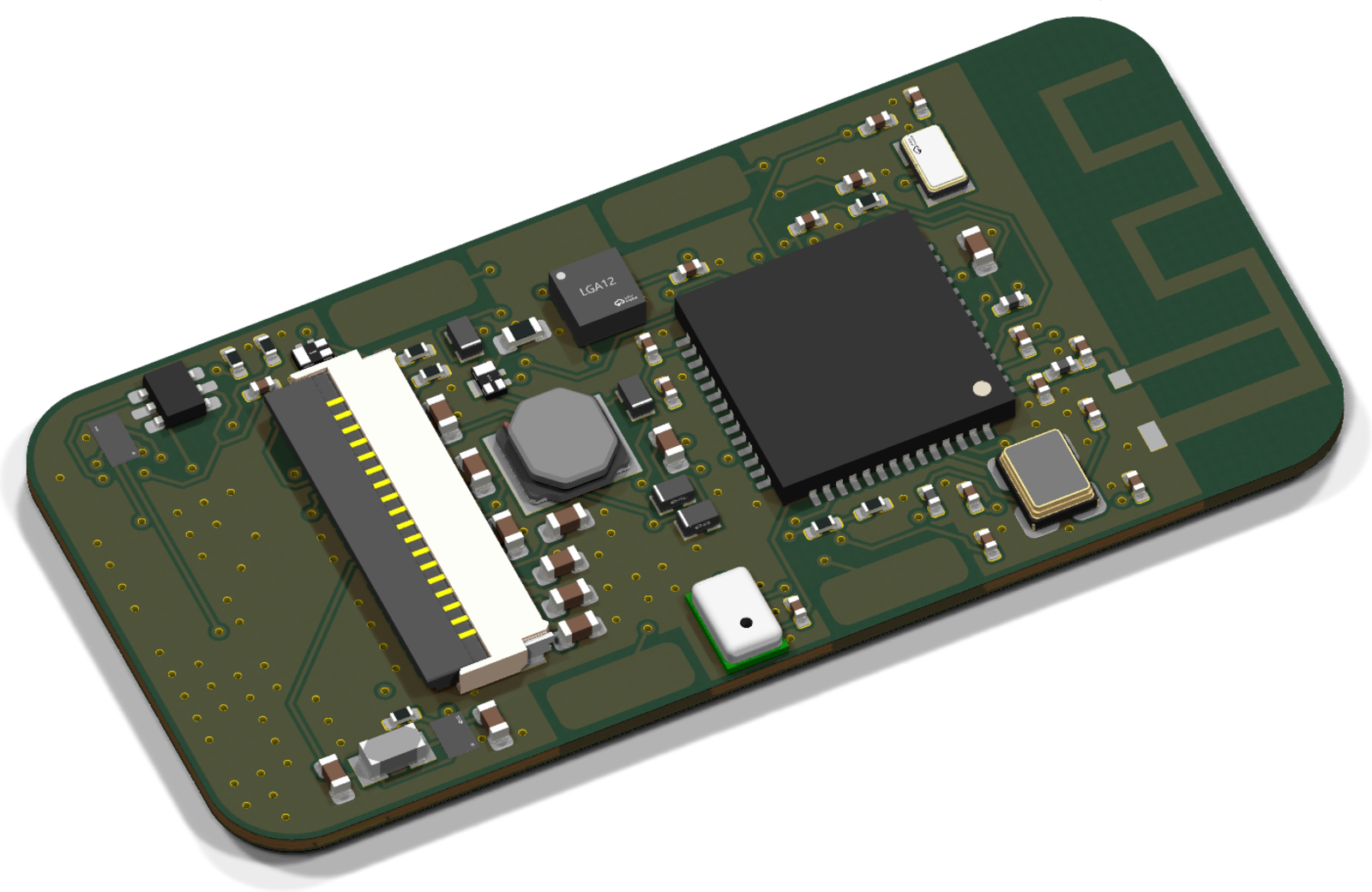
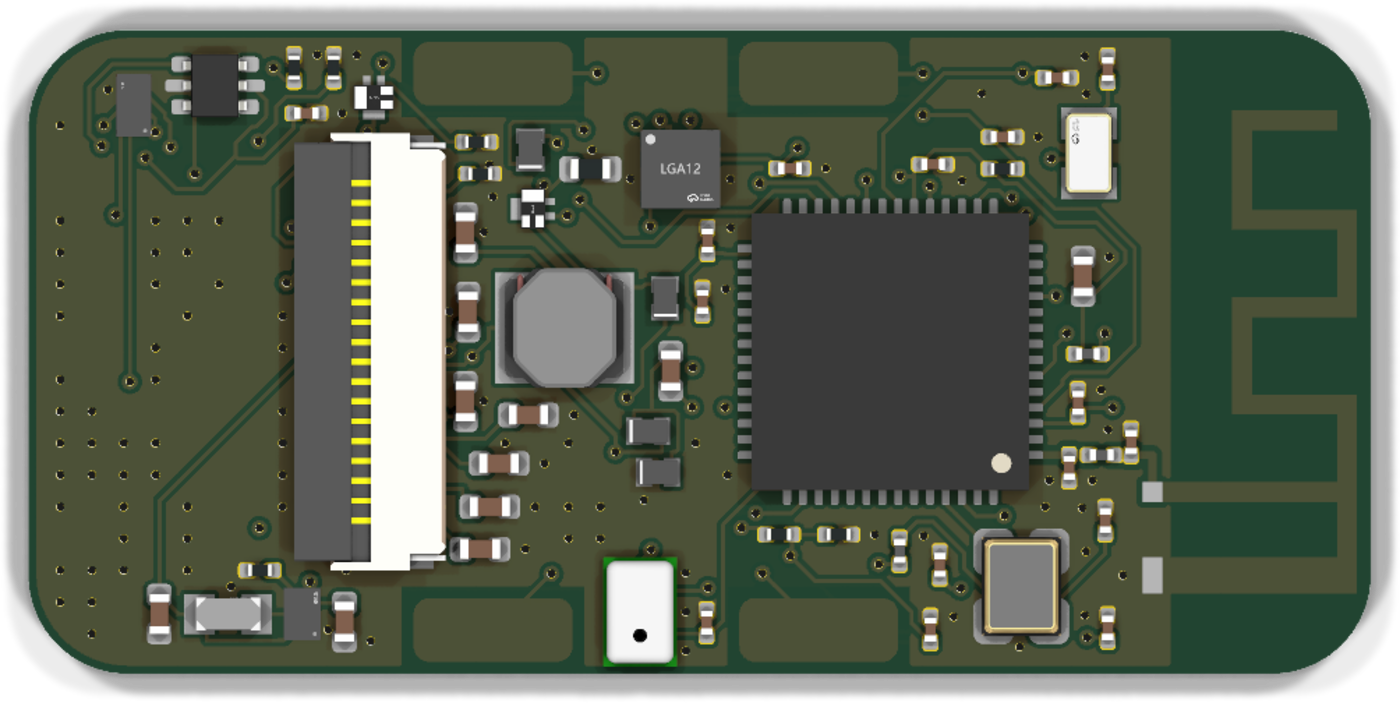
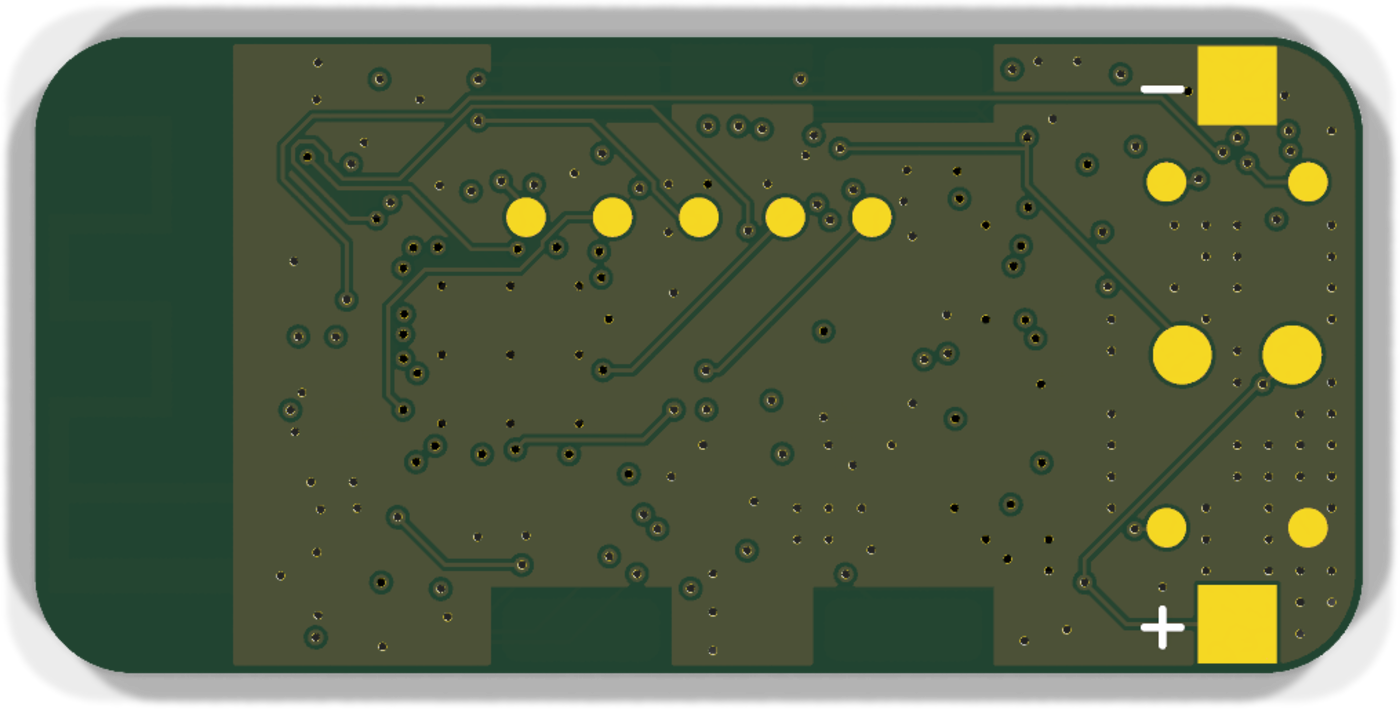
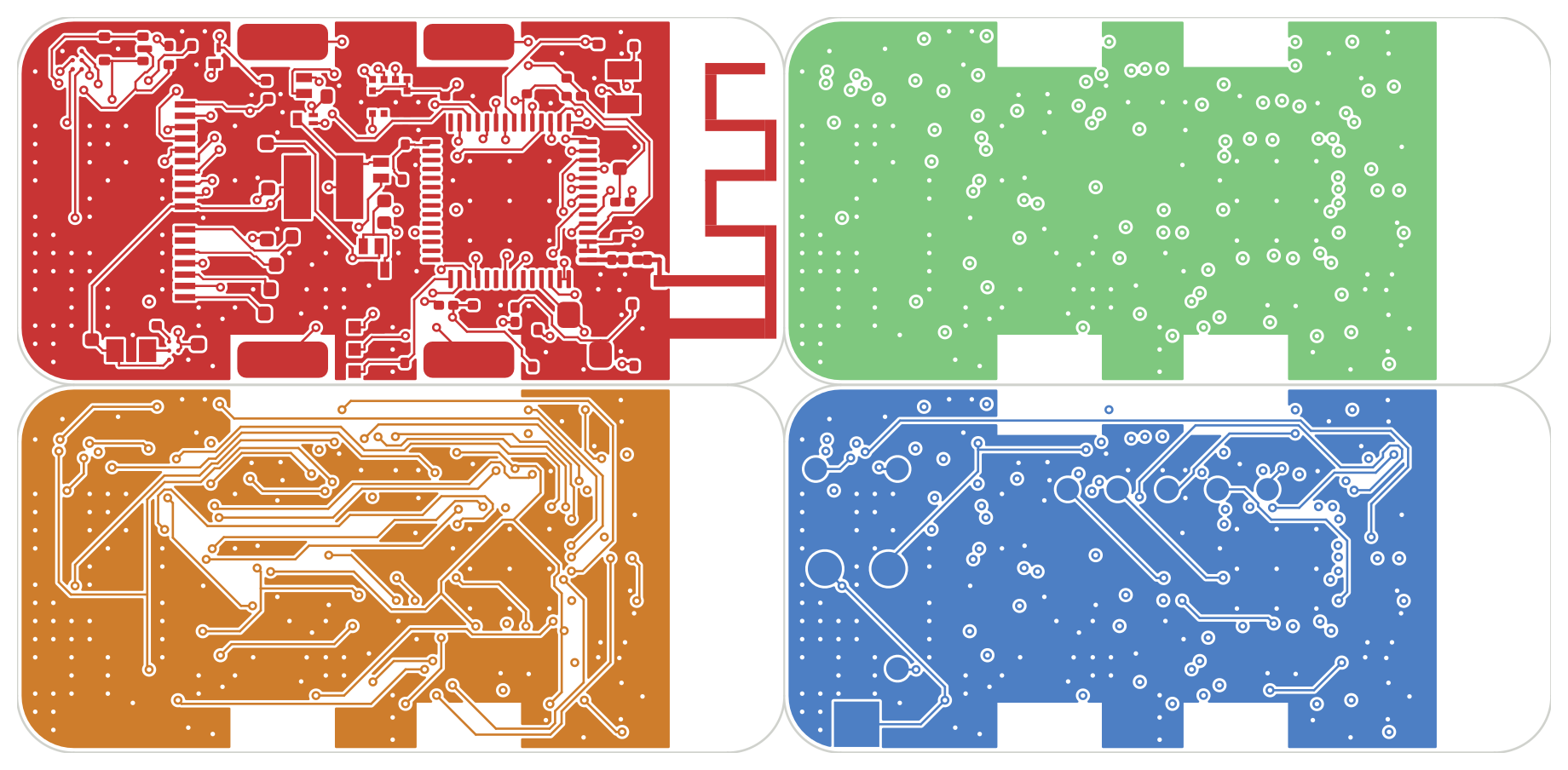
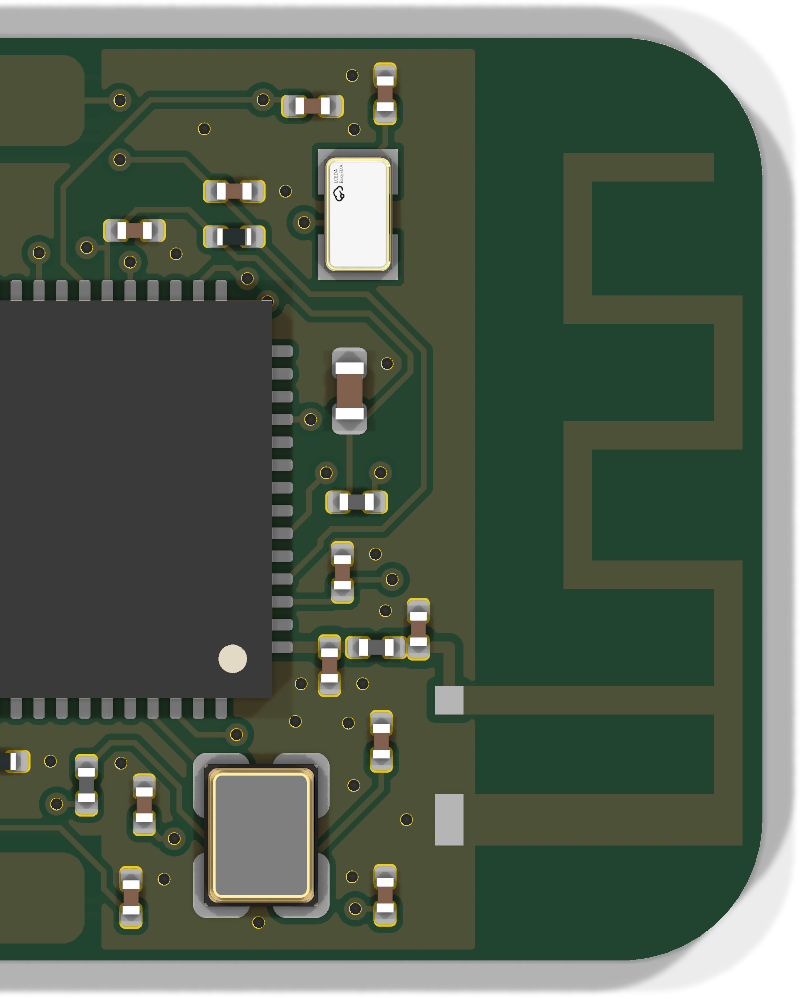
- Board: 33.8 × 16.2 × 0.6 mm, 4 layers, routed and DRC-clean with 0 warnings. The tallest part is now 1.0 mm, down from 1.2.
-
Rev A, designed end to end design
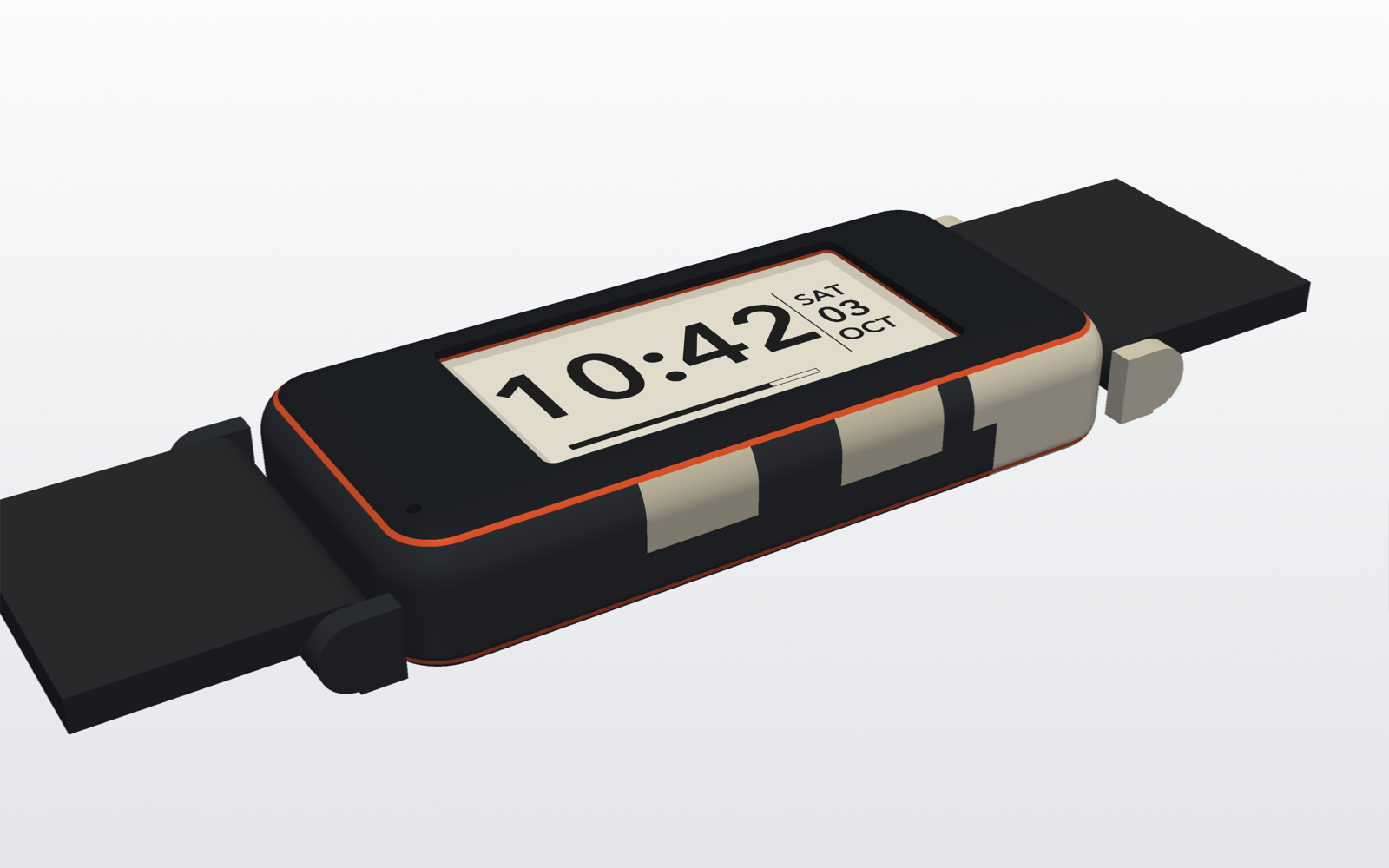
Board, case and antenna, all generated from code, with every check passing. Nothing is ordered yet; this is the design review, and it has already been through several rounds.
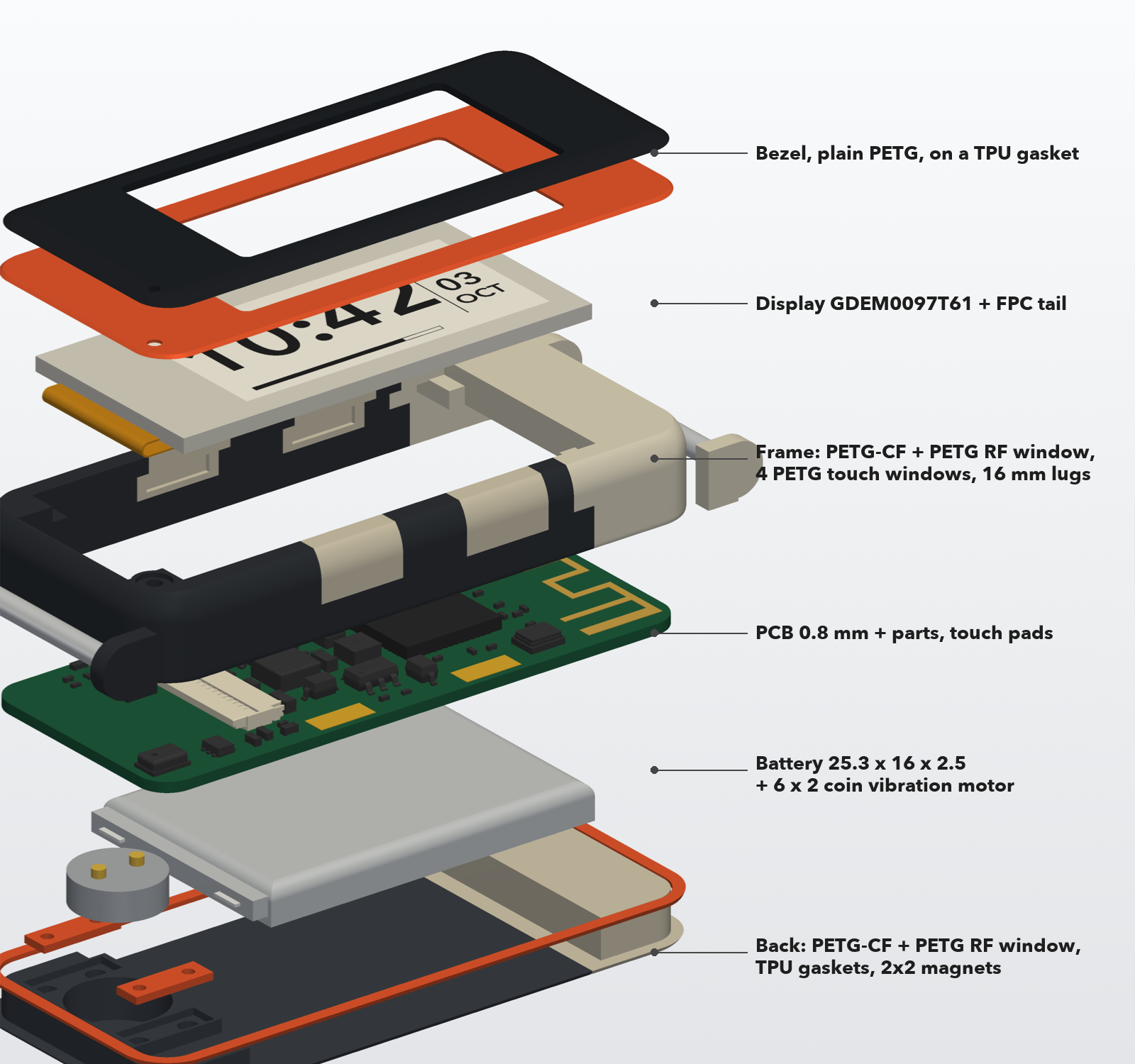
- Board: 38.5 × 16.5 mm, 4 layers, 54 parts placed by JLC.
- Chips: ESP32-S3, an ST LIS2DUX12 accelerometer (step counting at 2.7 µA), an RV-3032 RTC and the e-paper booster.
- Four capacitive touch pads instead of switches, a 6 mm coin motor on spring contacts, and a top-port PDM mic that draws 0 µA when off.
- ERC and DRC clean. The RF feed is hand-routed as a 50 Ω coplanar line.
- Antenna: an openEMS simulation showed Watchy's antenna would resonate at ~2.0 GHz inside our case and barely radiate. Trimmed by 6.64 mm and re-matched, it's predicted at −8 to −16 dB across the 2.4 GHz band. A re-run with the final case shape and the steel spring bar is still to do.
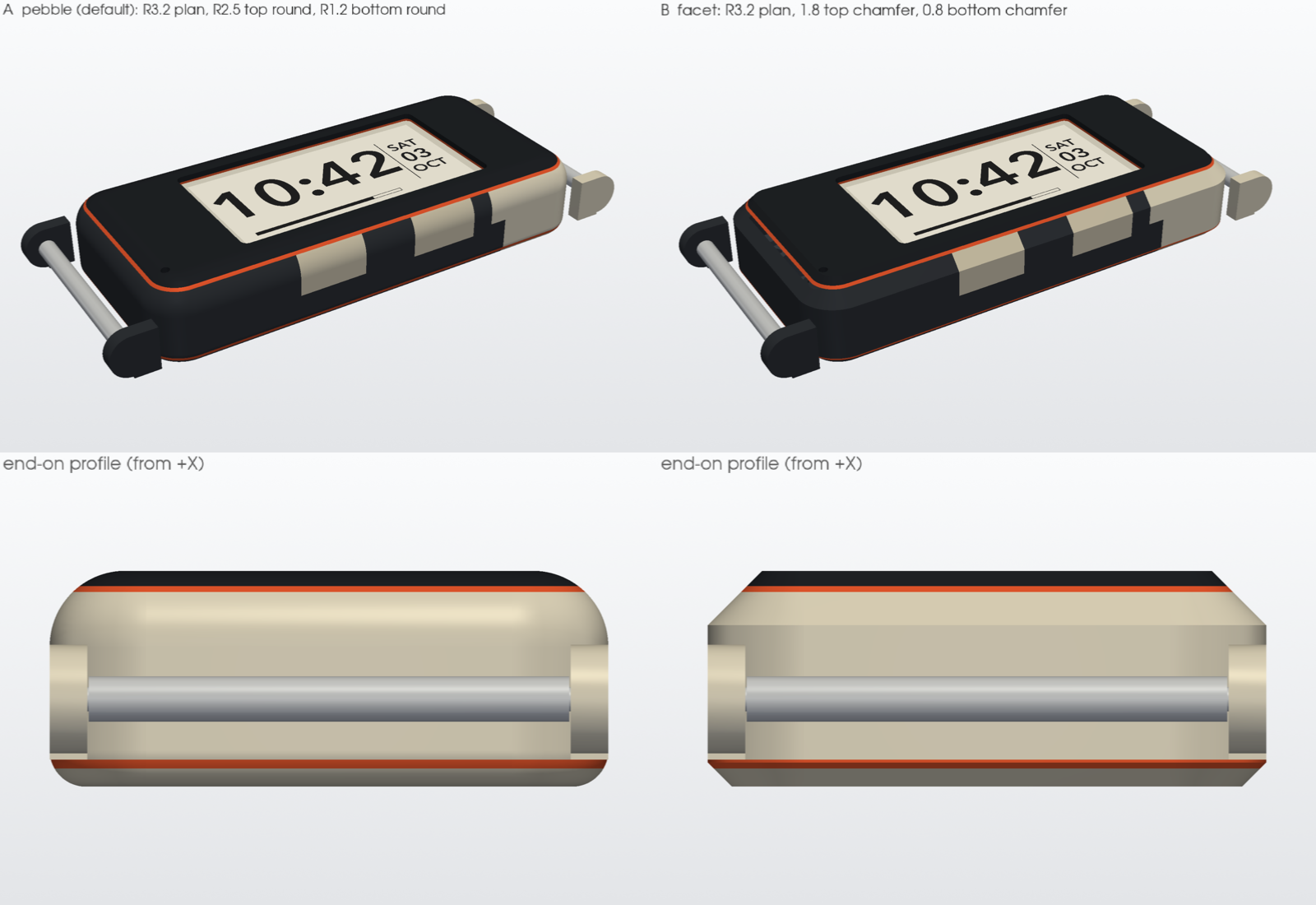
- Case: 40.5 × 18.5 × 7.15 mm (Charge 6: 36.7 × 23.1 × 11.2).
- "Pebble" shape: carbon-fiber PETG body, with a plain-PETG window over the antenna and solid windows over the touch pads.
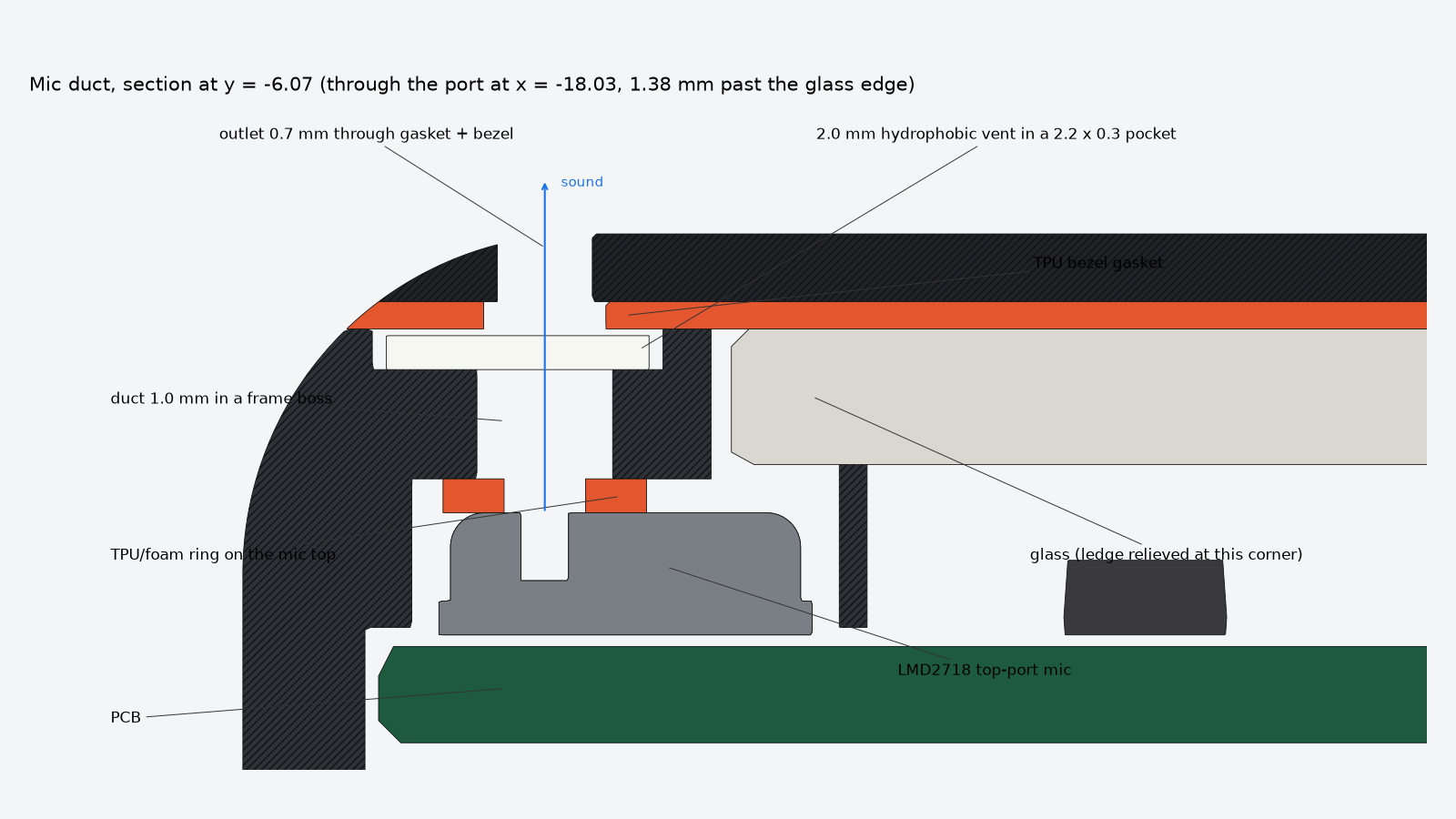
- Splash resistance from TPU gaskets, plus a vented mic duct.
- Standard 16 mm spring-bar straps and a magnetic pogo dock. The battery is the full 25 × 16 × 2.5 mm.
- Cost: about USD 120–130 for two assembled boards before shipping and tax. Parts are $14.61 per board after swapping the $15 BMA400 for the $4 LIS2DUX12.
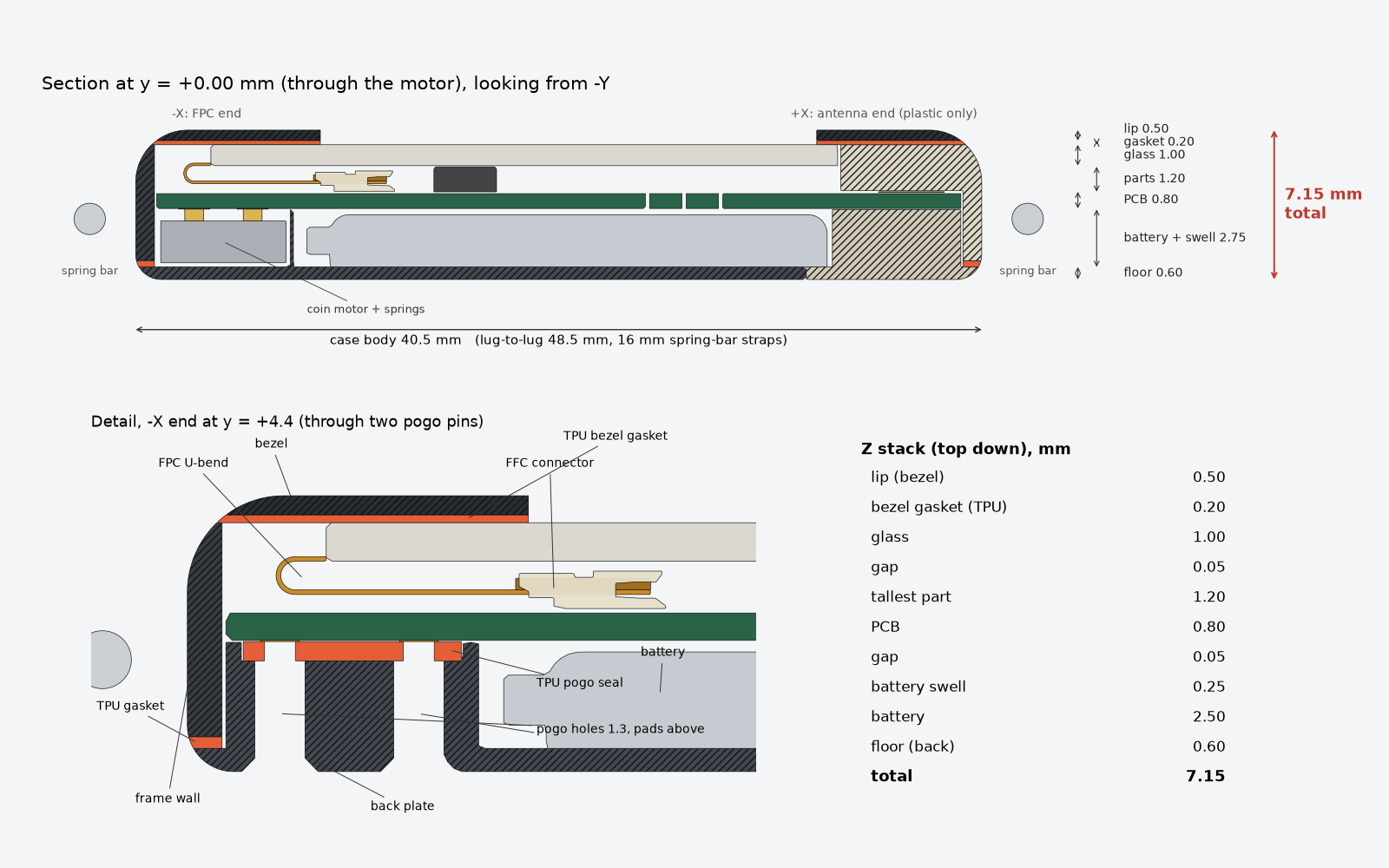
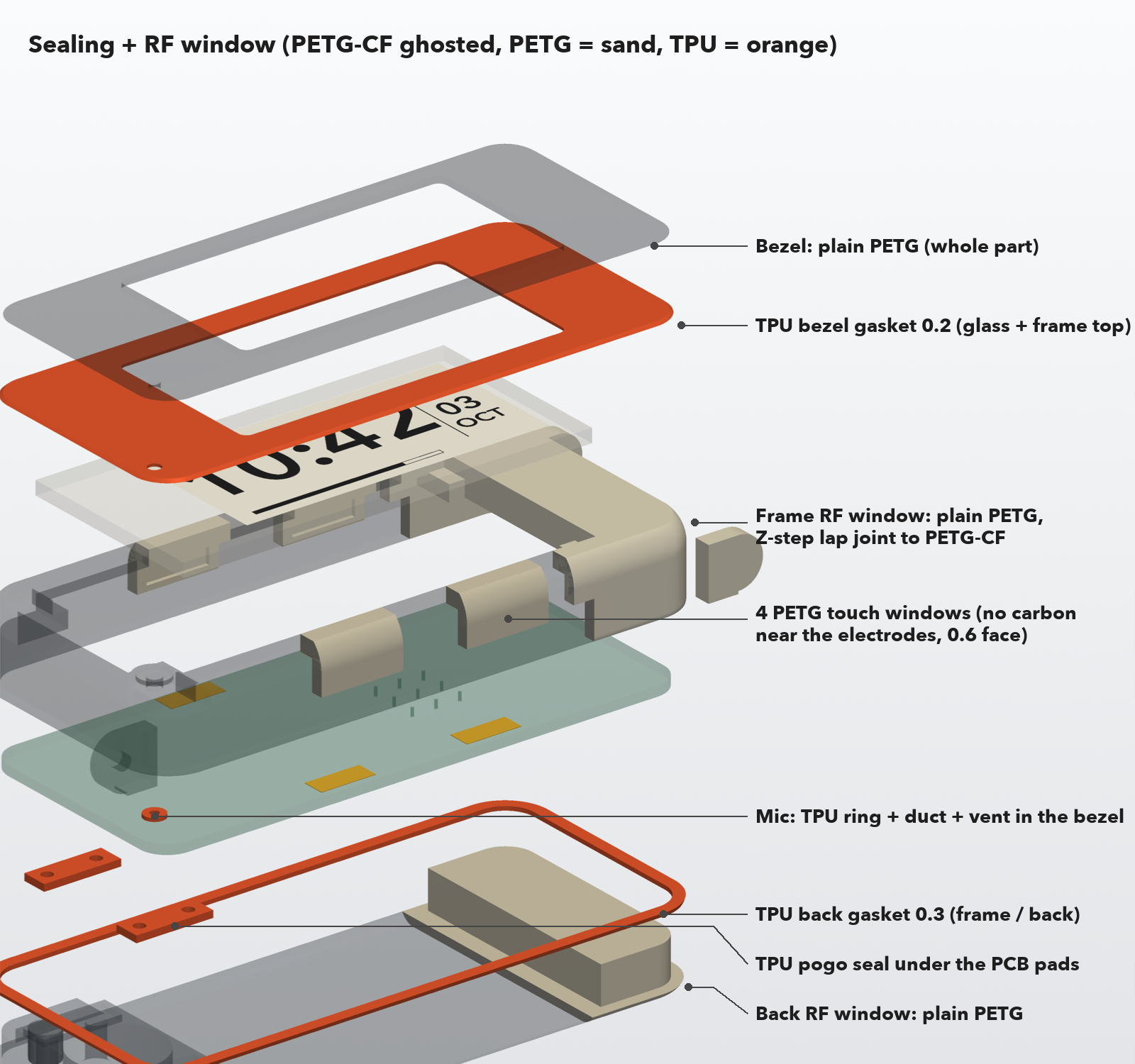
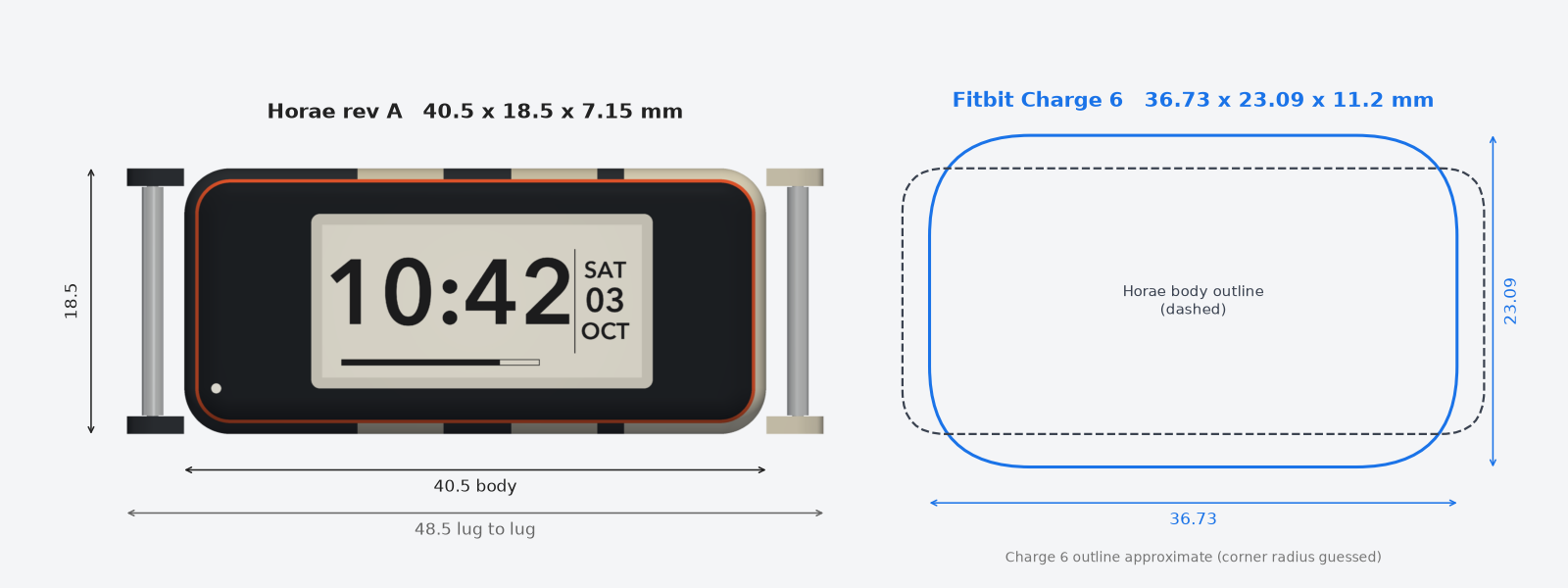
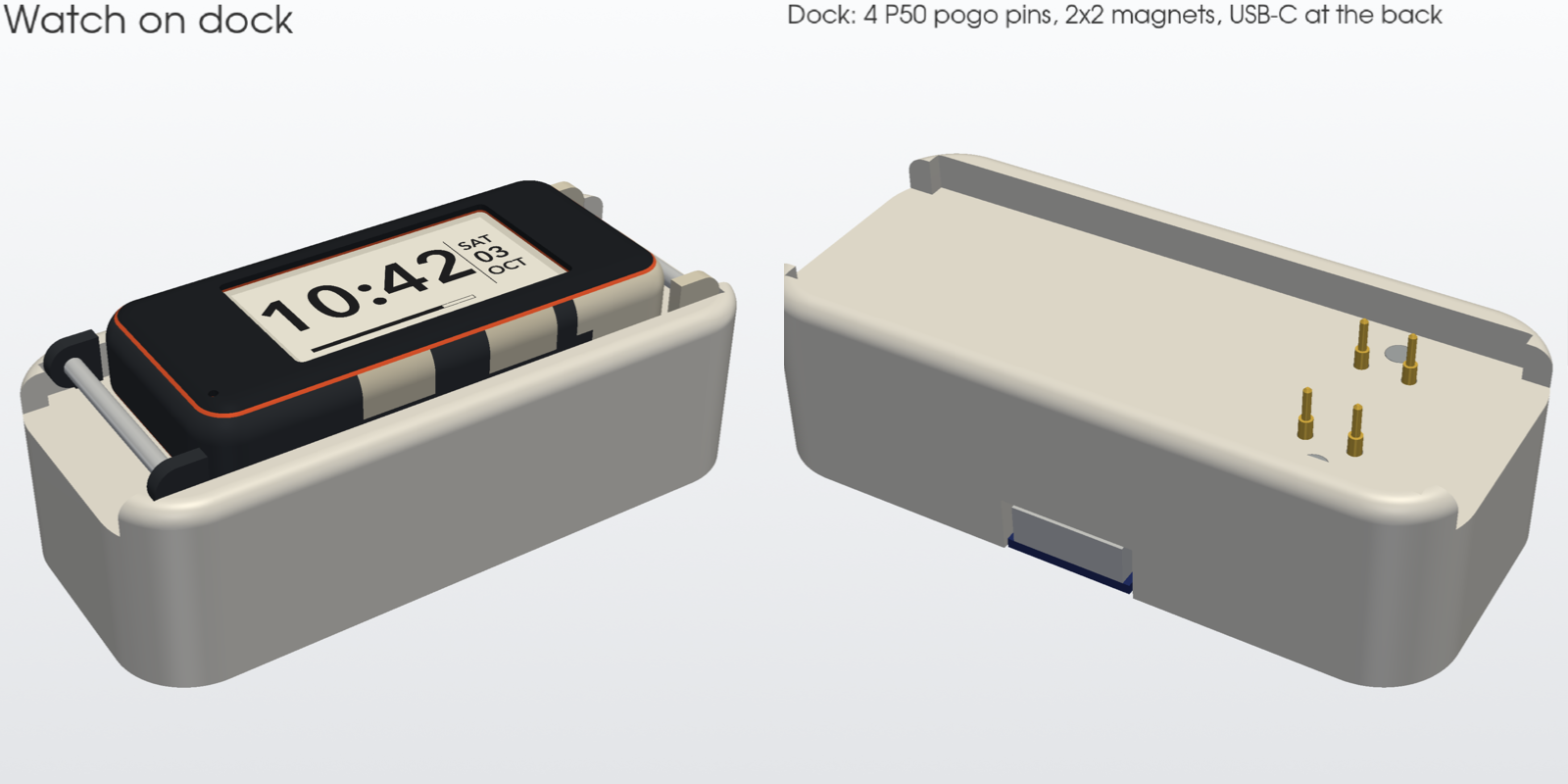
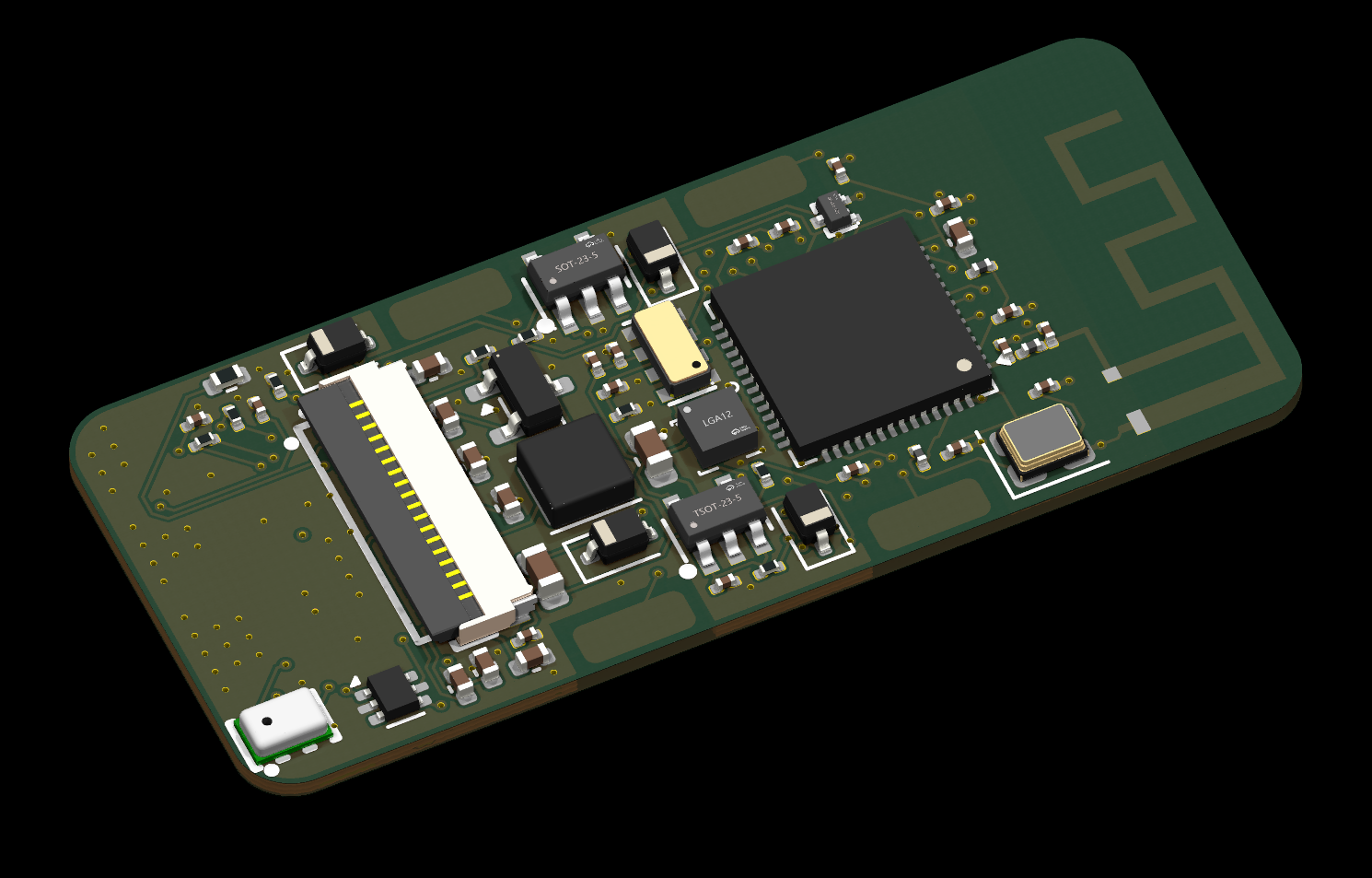
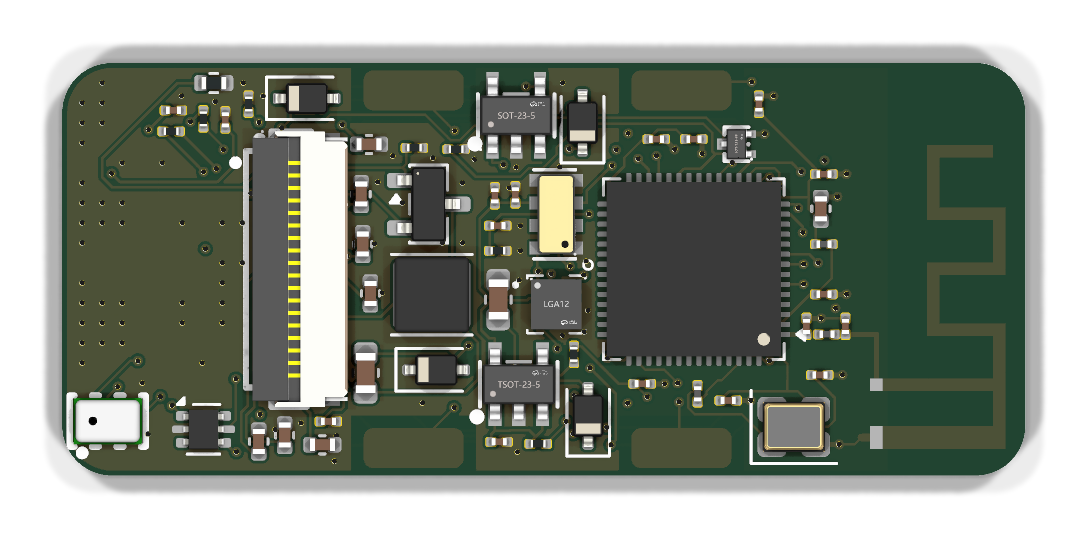
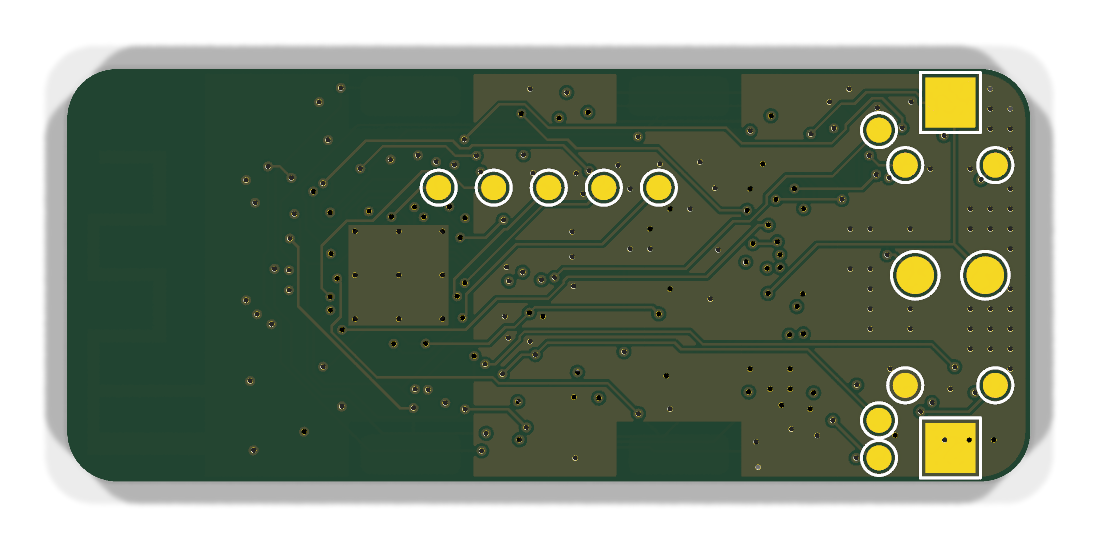
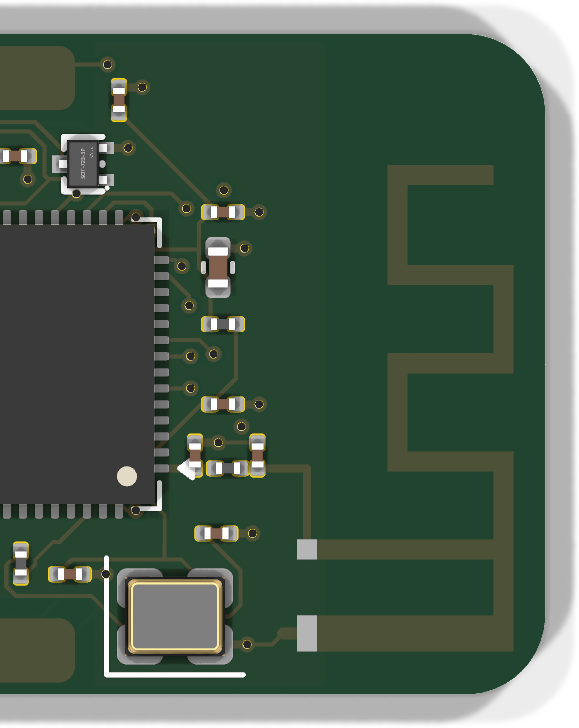
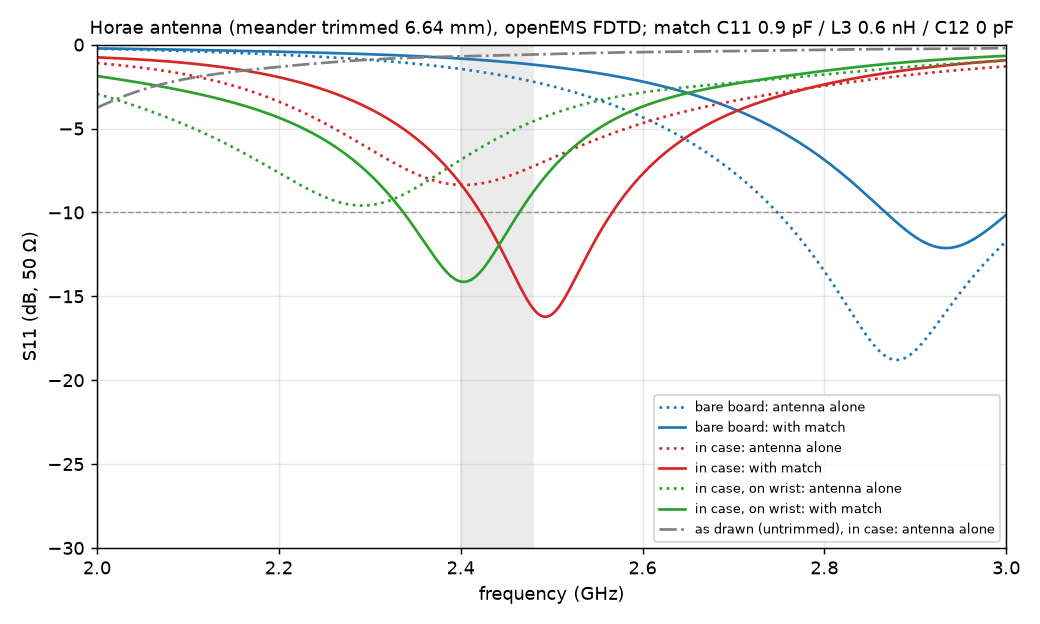
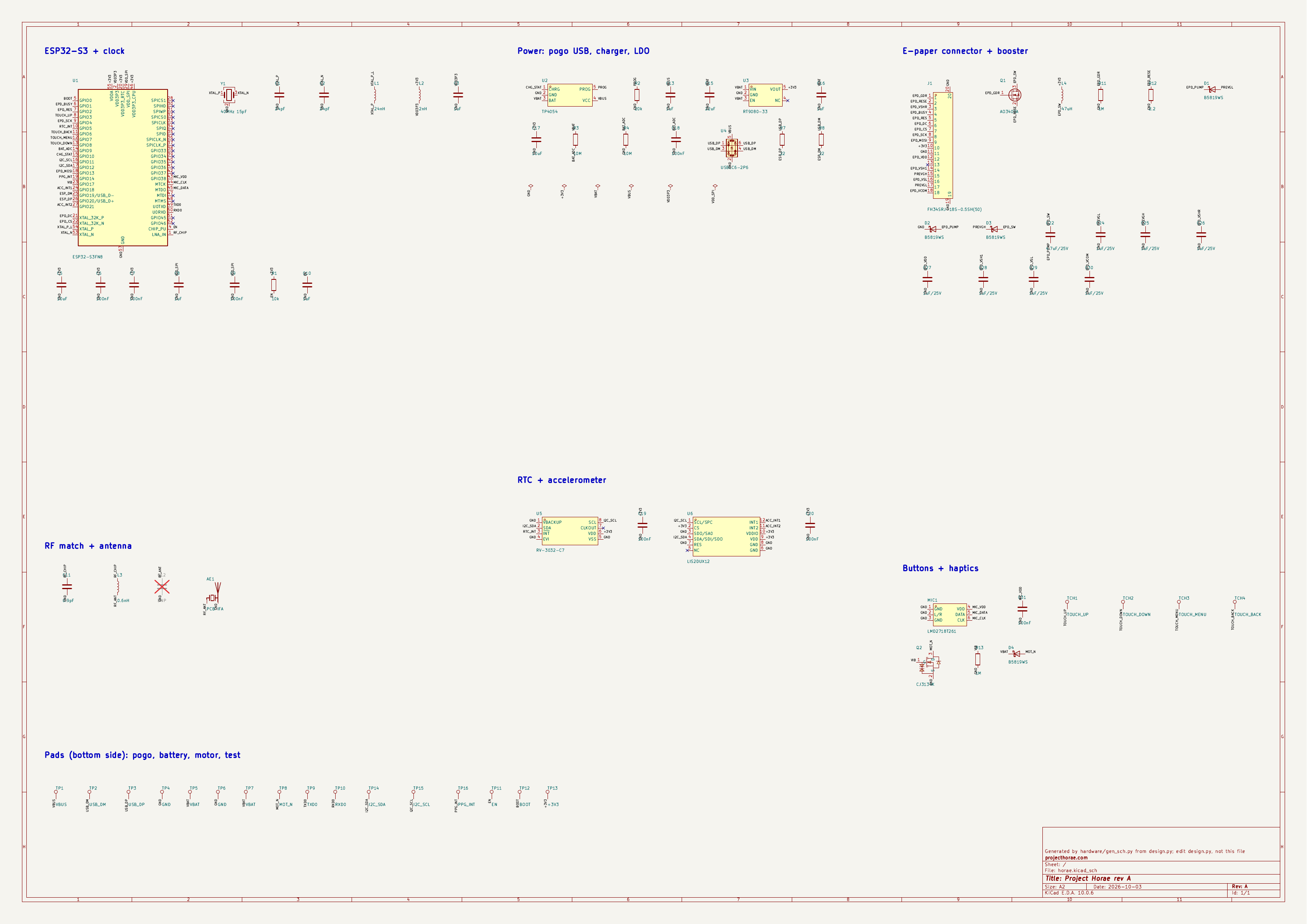
- Board: 38.5 × 16.5 mm, 4 layers, 54 parts placed by JLC.
-
Plan: straight to a custom board plan
- No dev-board stage. Rev A is a custom 4-layer, 0.8 mm board, fully assembled by JLCPCB. We plug in the display, solder the battery, and print the case.
- ESP32-S3, Wi-Fi kept. The same chip as Watchy, so we reuse its proven antenna and RF layout and its firmware.
- Battery-first parts. BMA400 accelerometer (4 µA while counting steps, vs ~25 µA for the BMA4xx family), RV-3032 RTC, 2 µA LDO, Wi-Fi once a day.
- Target: ~38 × 17.5 × 7 mm, against the Fitbit Charge 6's 36.7 × 23.1 × 11.2 mm.
- Charging: gold pogo pads on the back and a magnetic dock printed on the A1 mini. No USB socket.
- Tools: build123d for CAD, KiCad 10 for electronics.
-
Research: tools, batteries, displays research
Before designing anything, we surveyed what's available. The first-pass picks:
- Display: a 0.97" 184×88 bar-shaped e-paper (Good Display GDEM0097T61). It's 30×14×1 mm and uses an SSD1680, close kin to Watchy's controller. The runner-up is Sharp's 1.08" 160×68 memory LCD, which is the most Fitbit-like but hard to source.
- Battery: a stock 2.4–3 mm, 100–130 mAh LiPo pouch. Sodium-ion is a no for now: the smallest cells sold are 18650s.
- Electronics: fork Watchy's KiCad files into KiCad 10 and script everything with
kicad-cli. Boards come from JLCPCB, 4-layer at 0.6–0.8 mm, assembled, shipped by DHL to Vancouver. - CAD: build123d (Python, STEP in and out) for the case. The KiCad board drops straight in for fit checks. Slicing and printing on the Bambu A1 mini run from the command line.
The open question is the chip: keep the ESP32-S3 and Watchy's firmware, or switch to an nRF52/nRF54 for roughly 5× the battery life.
-
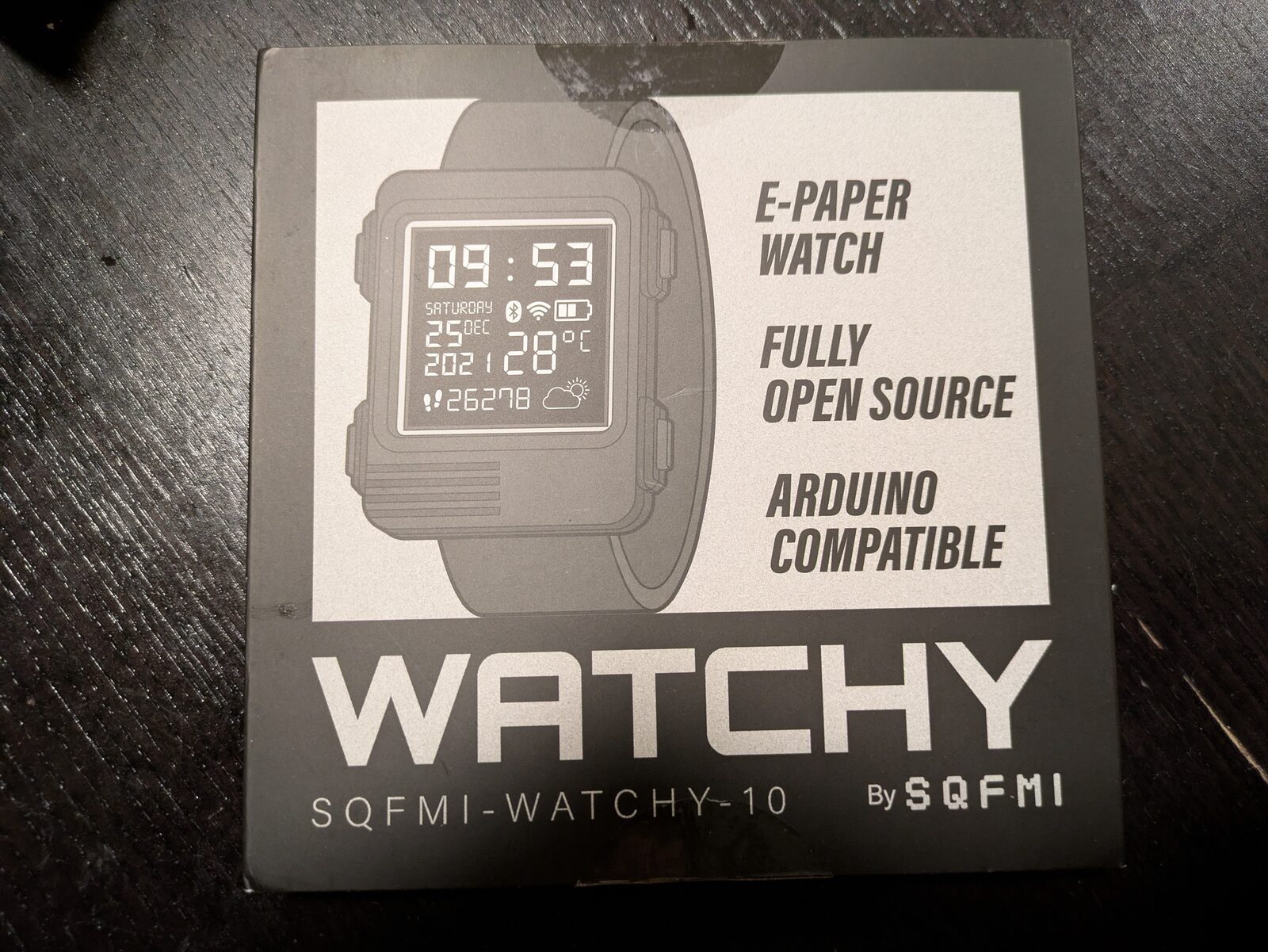
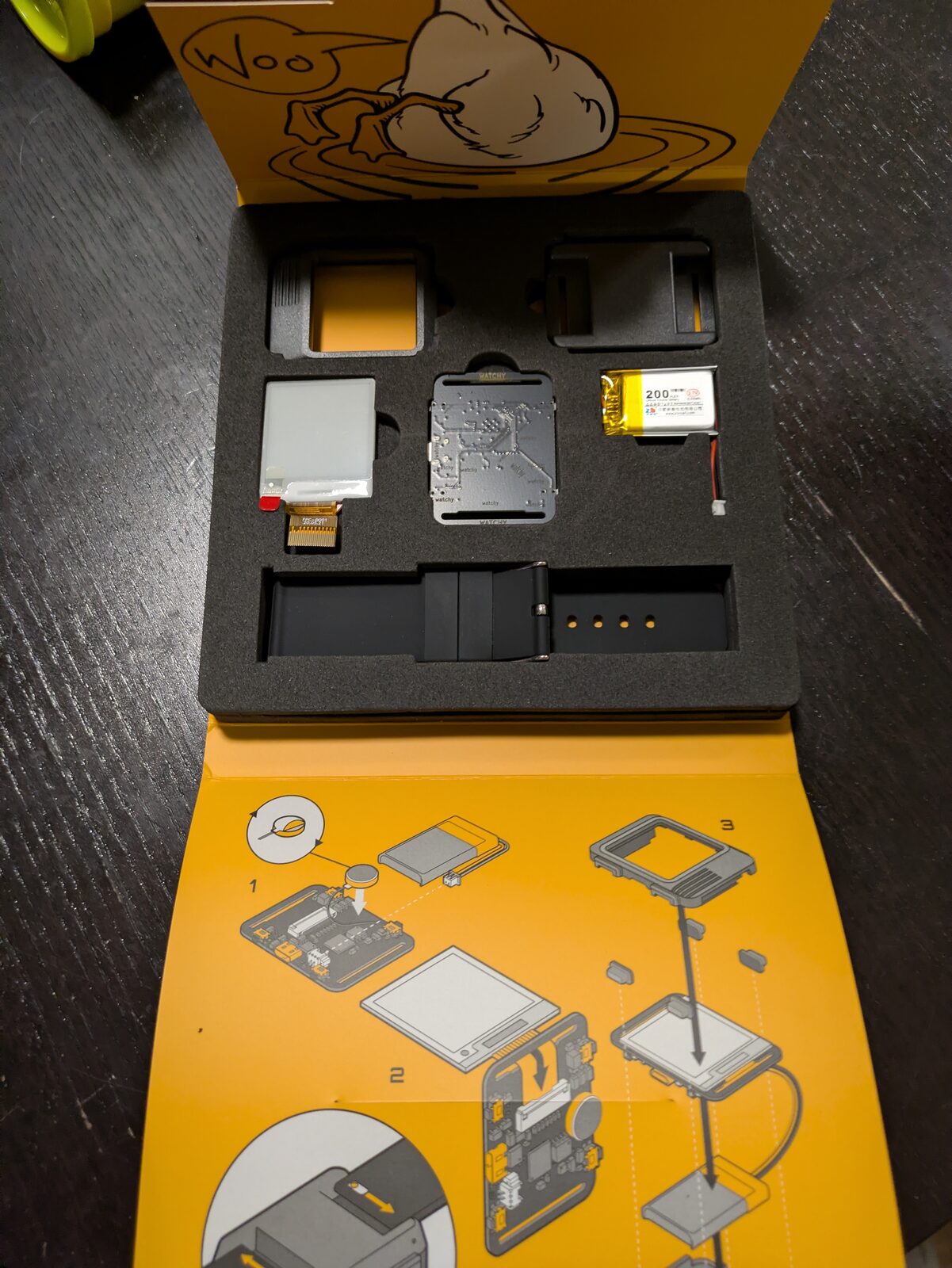
Unboxing the Watchy
The starting point: an original Watchy by SQFMI. ESP32, a 1.54" 200×200 square e-paper panel, four buttons, a LiPo, fully open hardware and firmware. Project Horae keeps the idea and changes the shape: thinner, narrower, and a better fit on a wrist.
Inside: the 1.54" e-paper panel, the PCB, a 200 mAh LiPo, the case parts and a strap. That's everything Horae has to shrink.